Online batch one-click light on/off
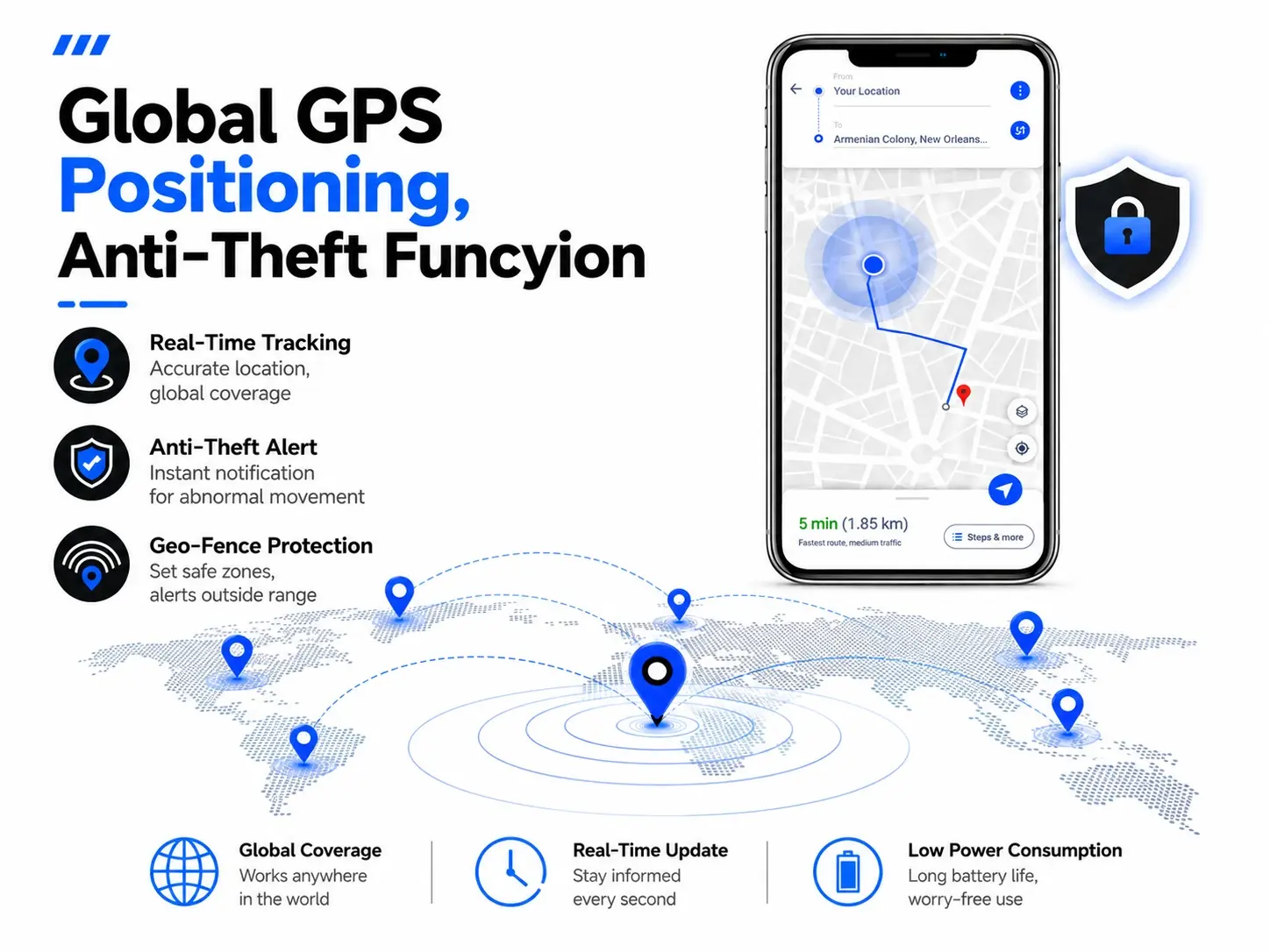
Global GPS Positioning,Anti-Theft Function
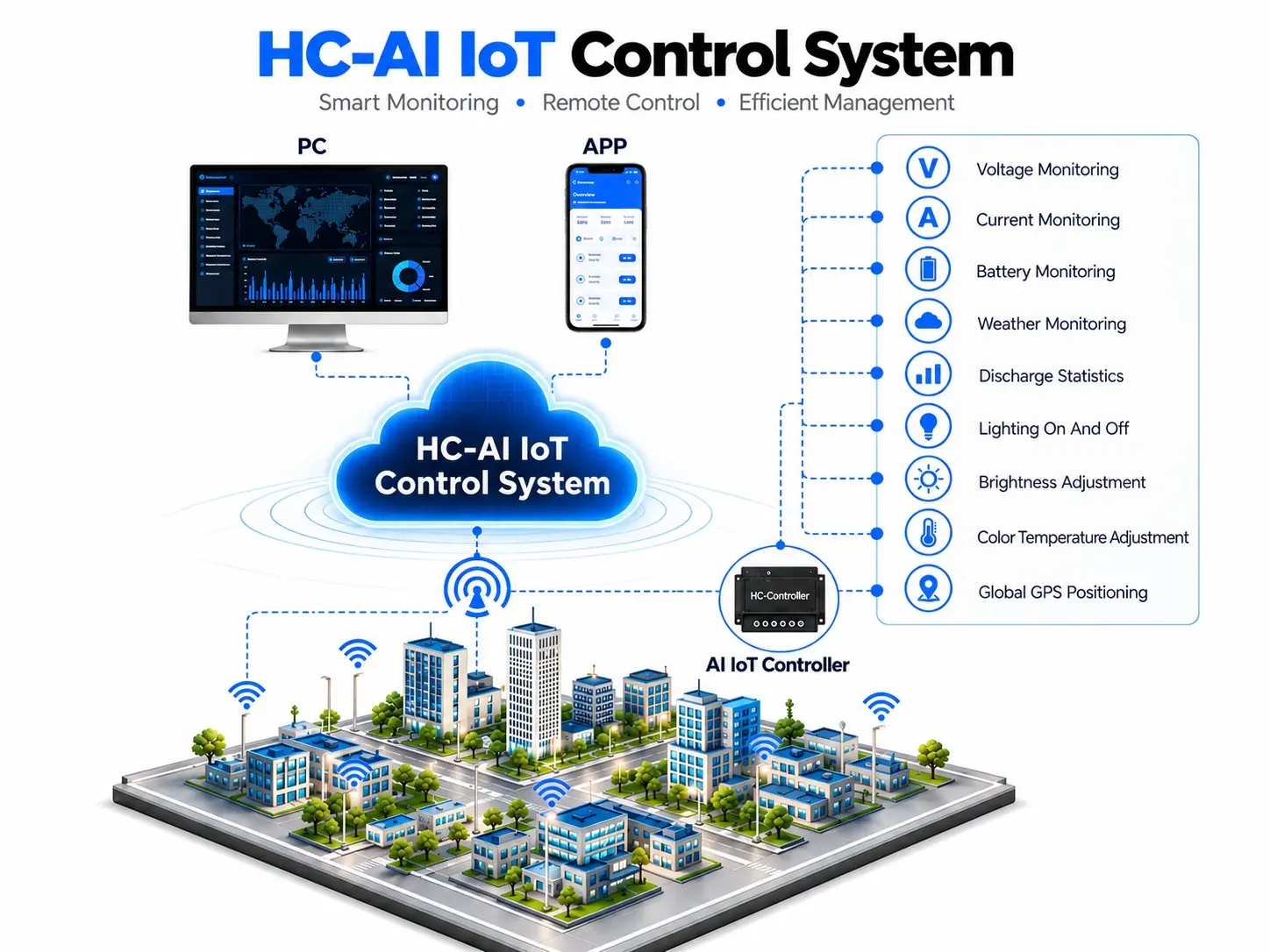
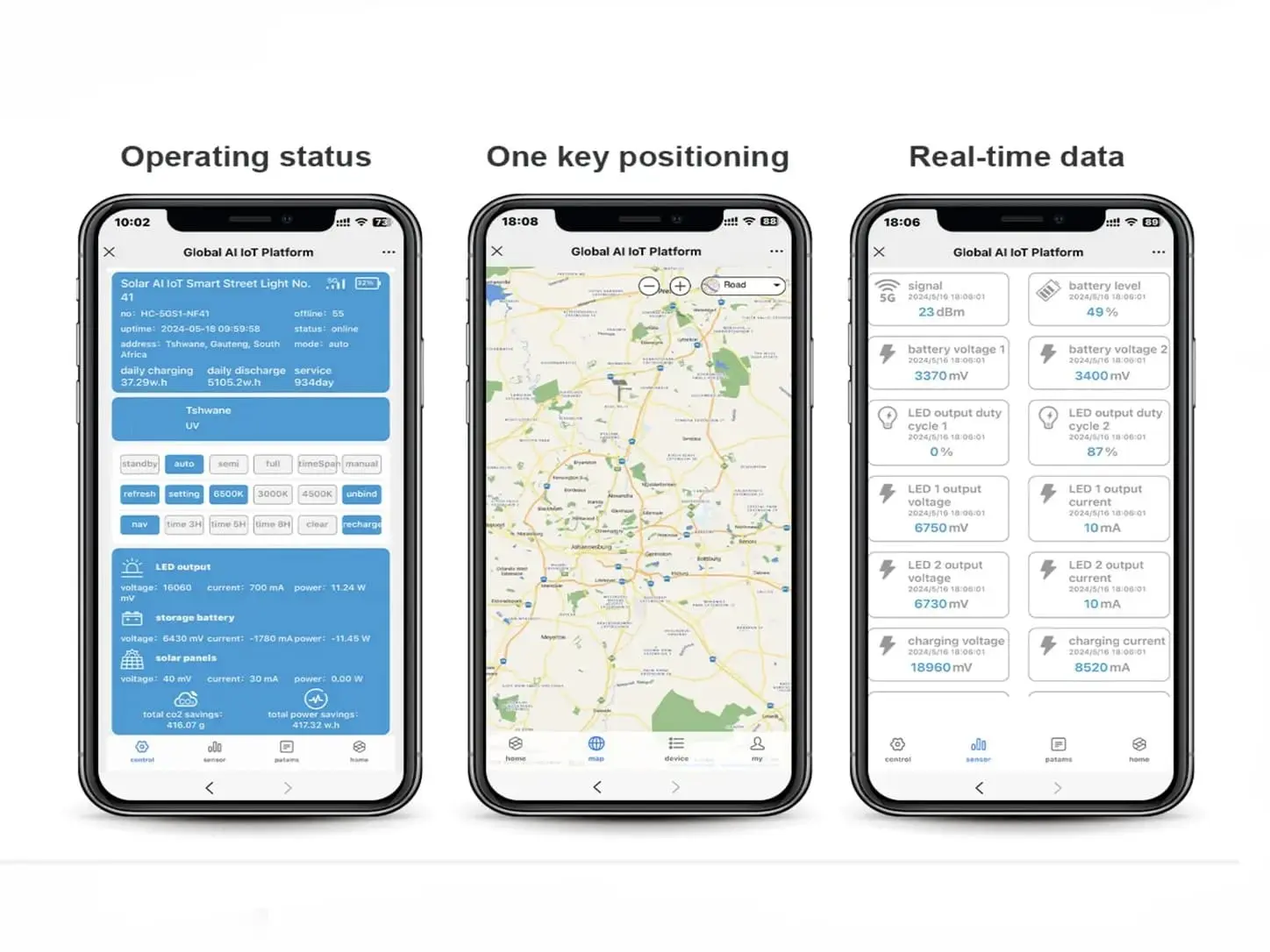
Online Cloud Platform Management
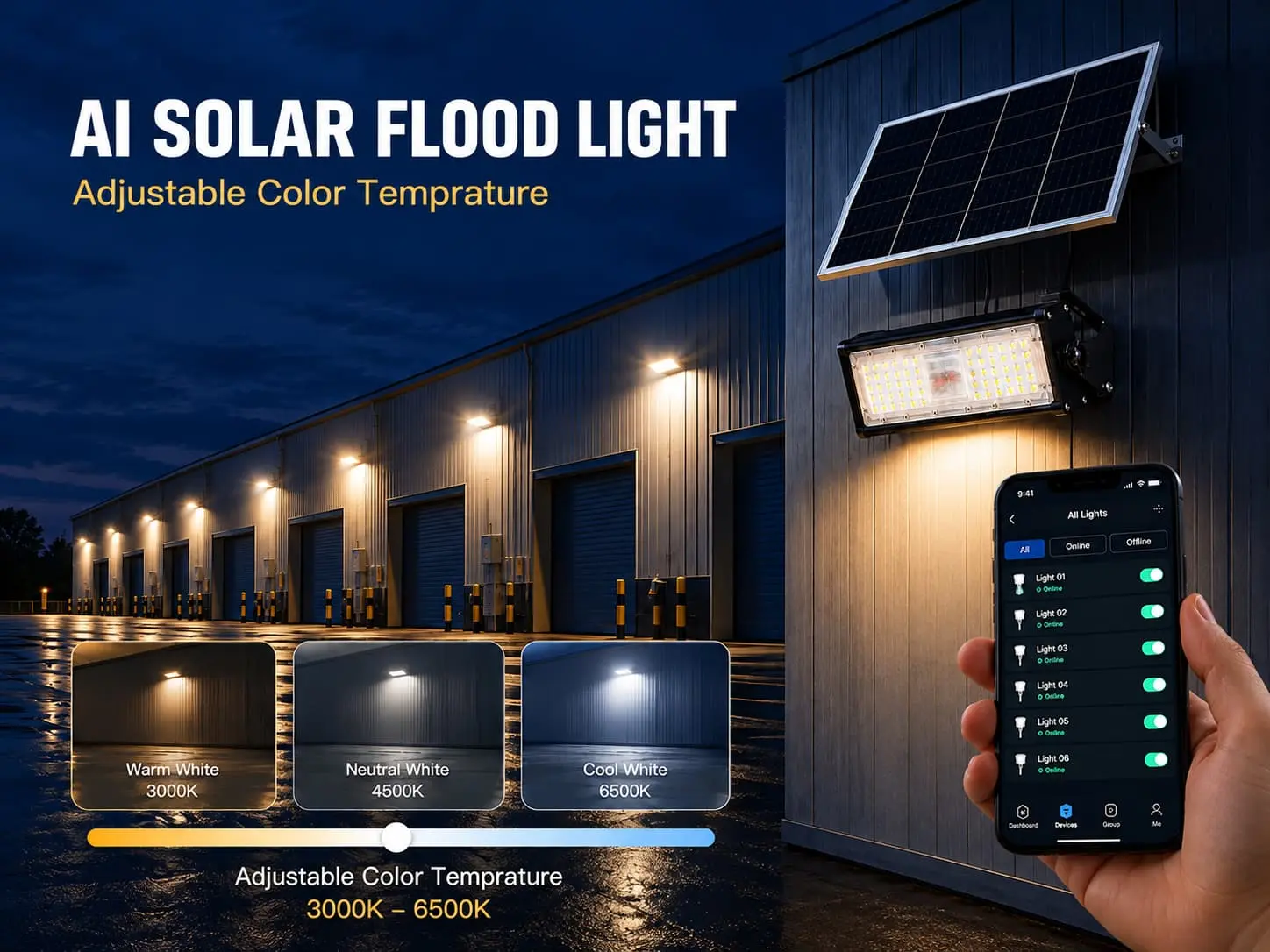
Adjustable Color Temperature
Adjustable Brightness
Remote Upgrade
Battery Monitoring
Voltage Monitoring
Current Monitoring
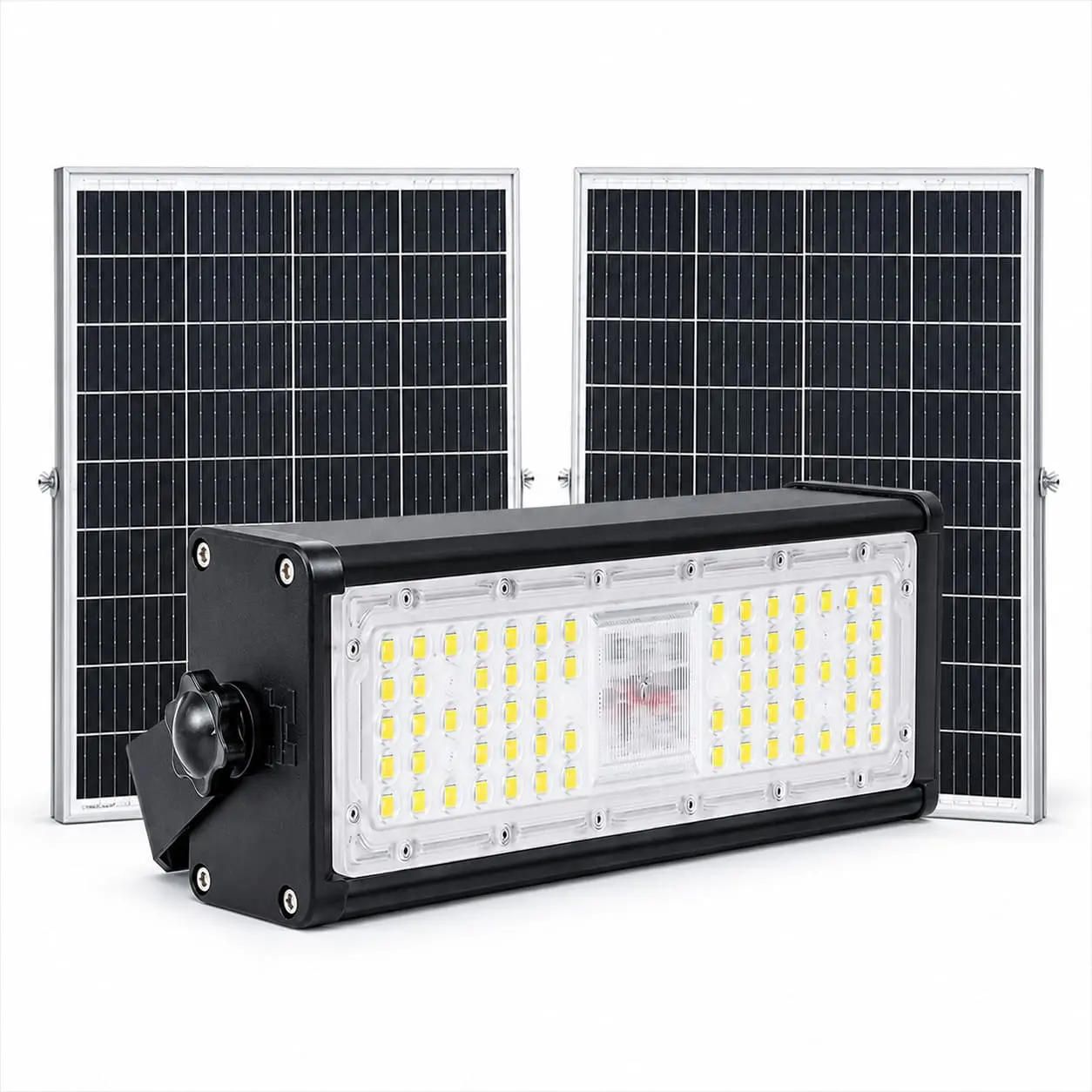
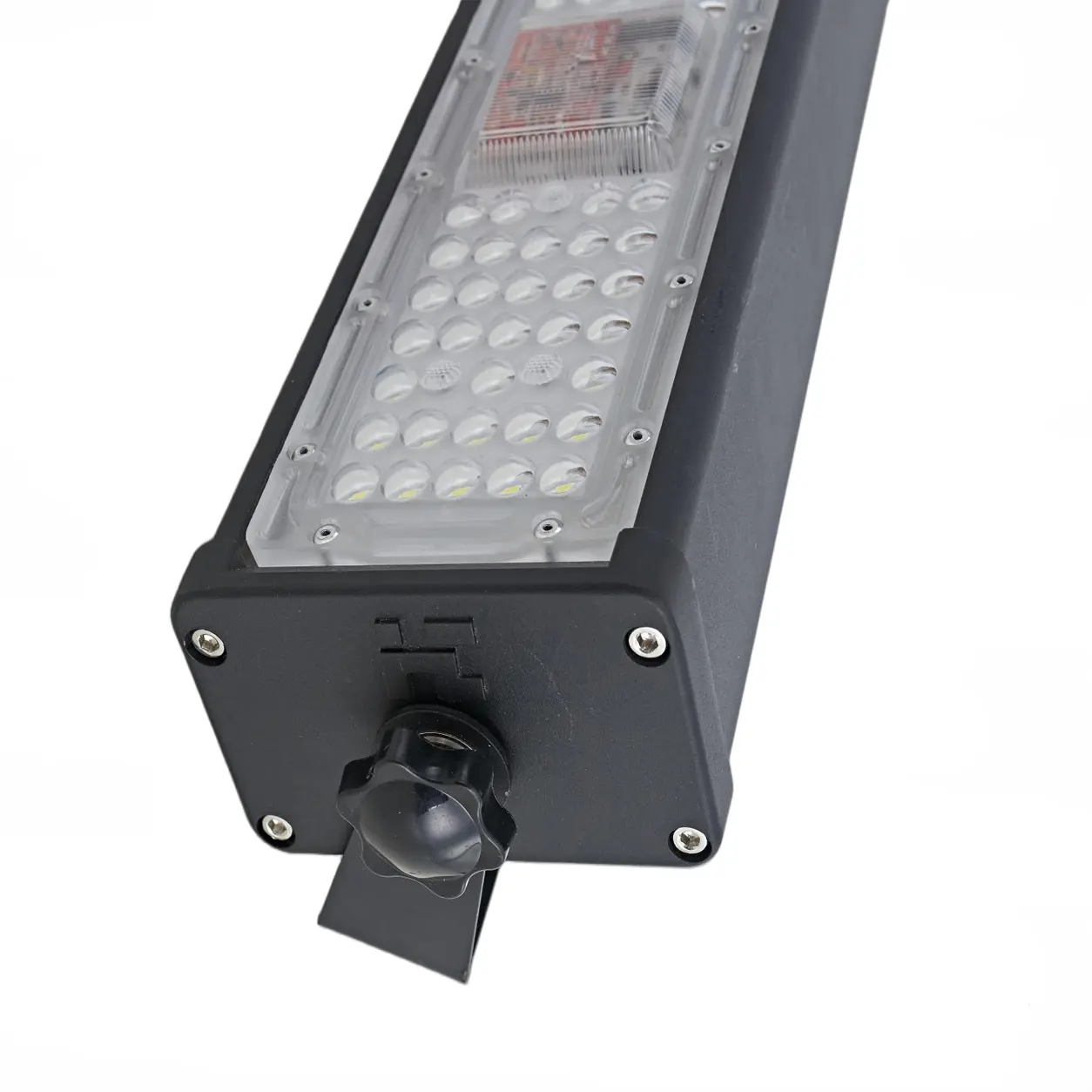
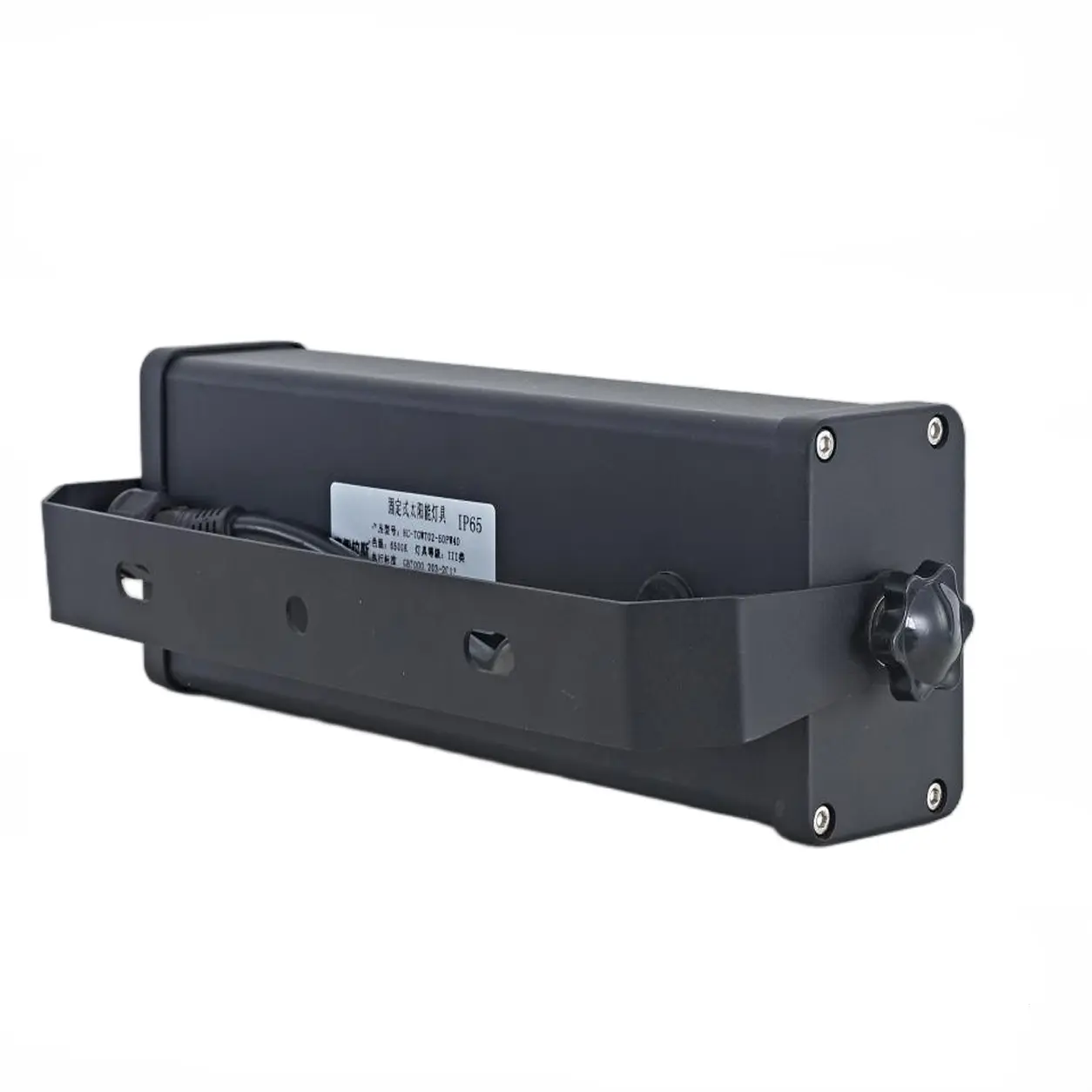
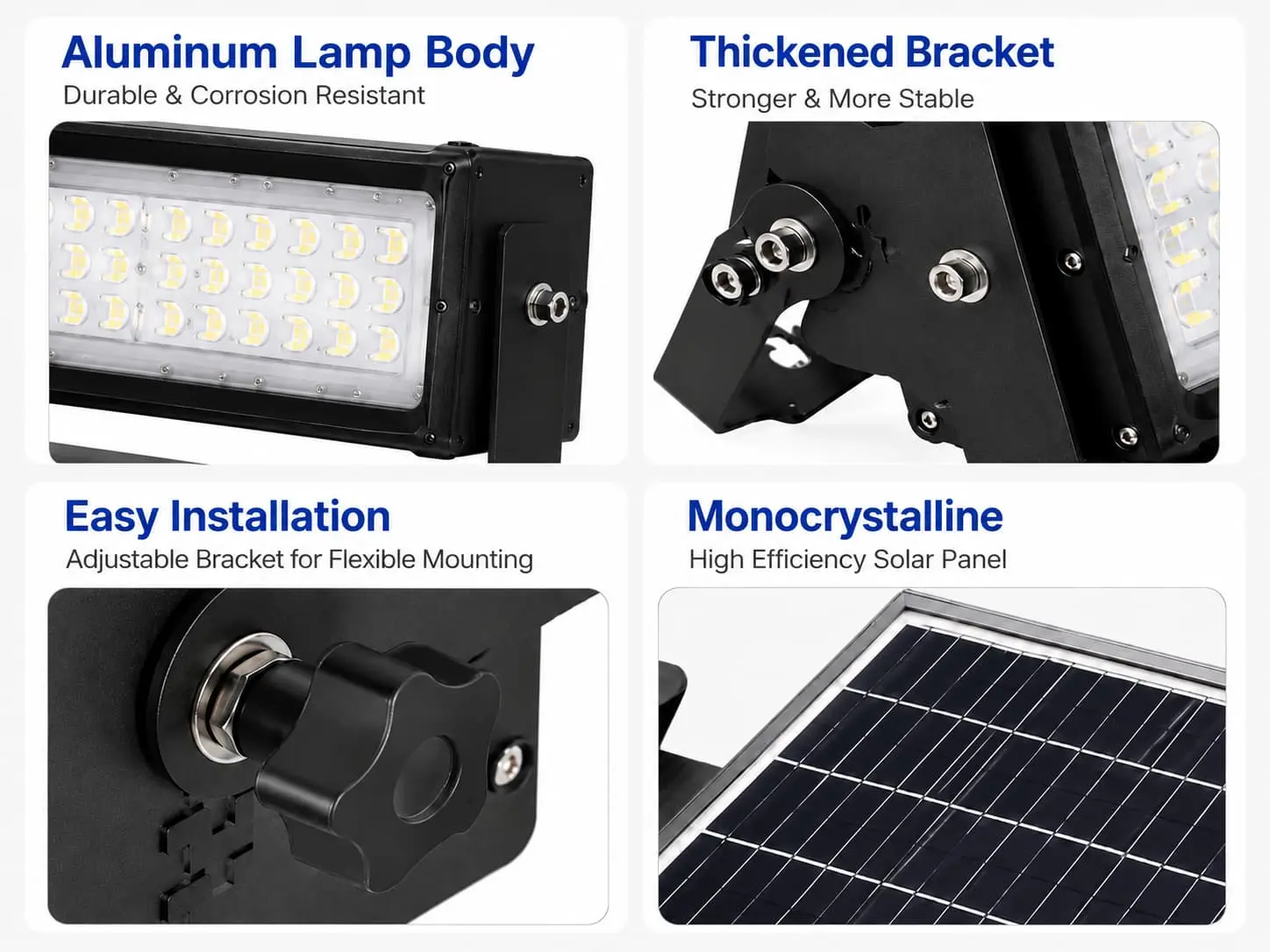
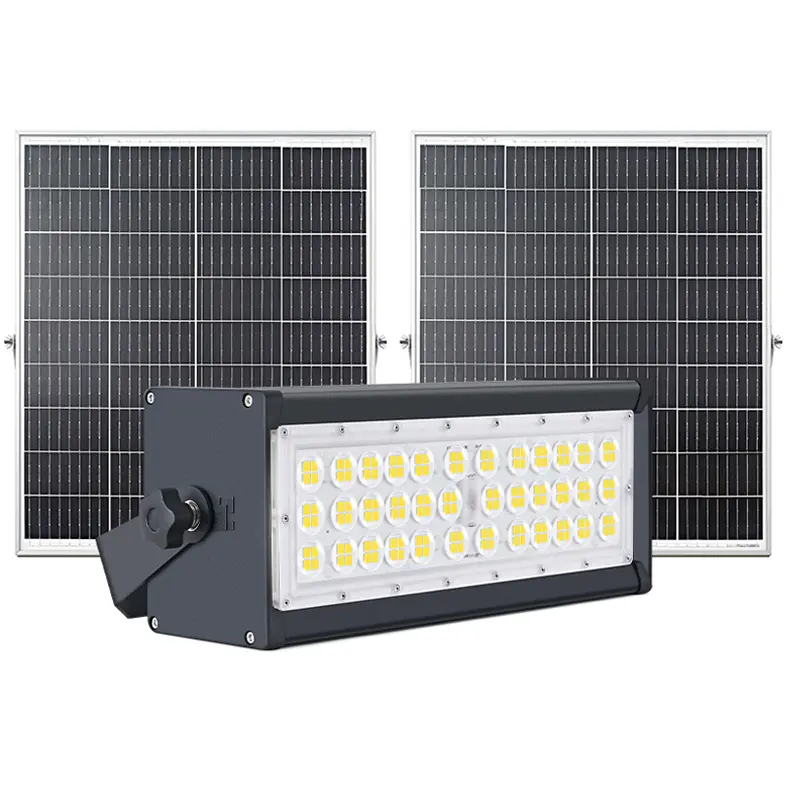
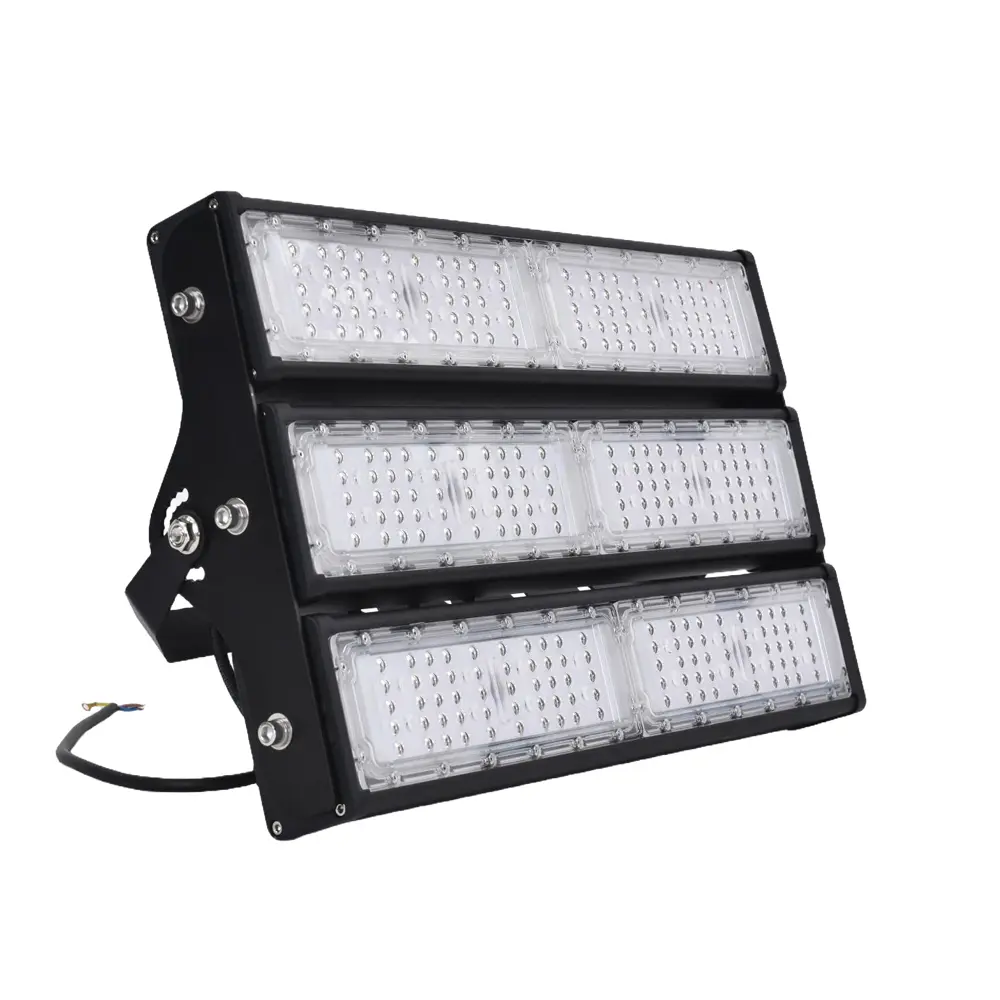
Featuring industrial-grade materials and an aluminum housing, this smart floodlight—protected by a proprietary design patent—is ideally suited for locations requiring high brightness and intelligent management.
AI IoT Solar Control System
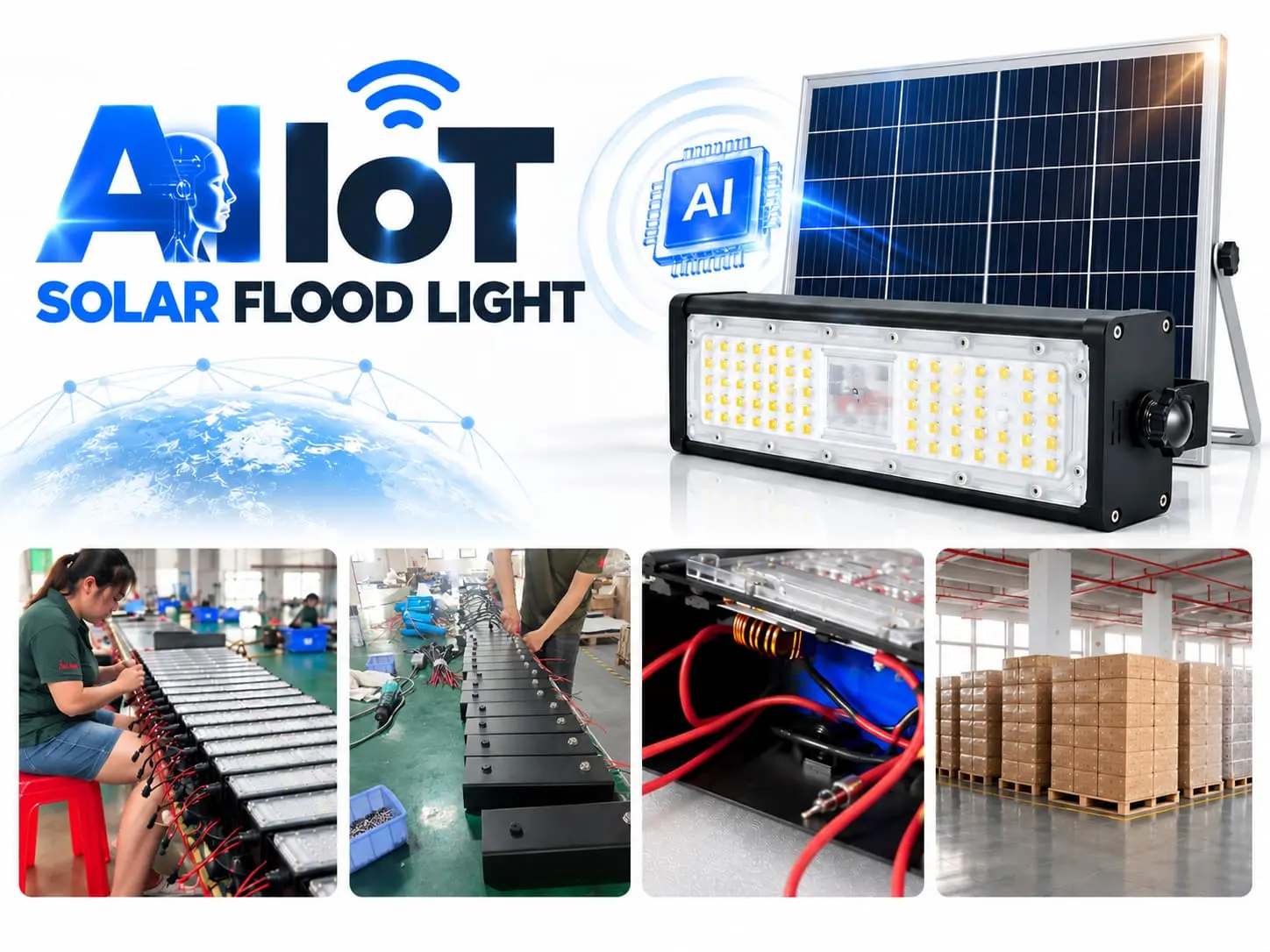
The novel AI-IoT Solar Floodlight system comprises four major components such as solar power, battery panels, LED floodlight, and IoT system. This model uses CREE LED chips and MPPT controller, which allows for remote control through a smartphone application that supports functions like switch on/off, dimming, and mode selection. Sensors help monitor the environmental data, which includes traffic flow and weather conditions, to guarantee the best lighting performance. The system provides automated fault notifications throughout 24 hours and allows monitoring the status of the light remotely. In addition, this model comes with GPS positioning, anti-theft technology, remote firmware updates, weatherproof system monitoring, and unique identification number of the device.
IoT Smart Solar Flood Lighting Management
The IoT smart lighting system connects solar flood lights through 2G, 4G, or NB-IoT communication. Operators can use the cloud platform and web or mobile interface to monitor operating data, manage multiple lighting points, adjust settings, and receive fault alerts remotely.
AI solar light:Global GPS Positioning,Anti-Theft Funcyion
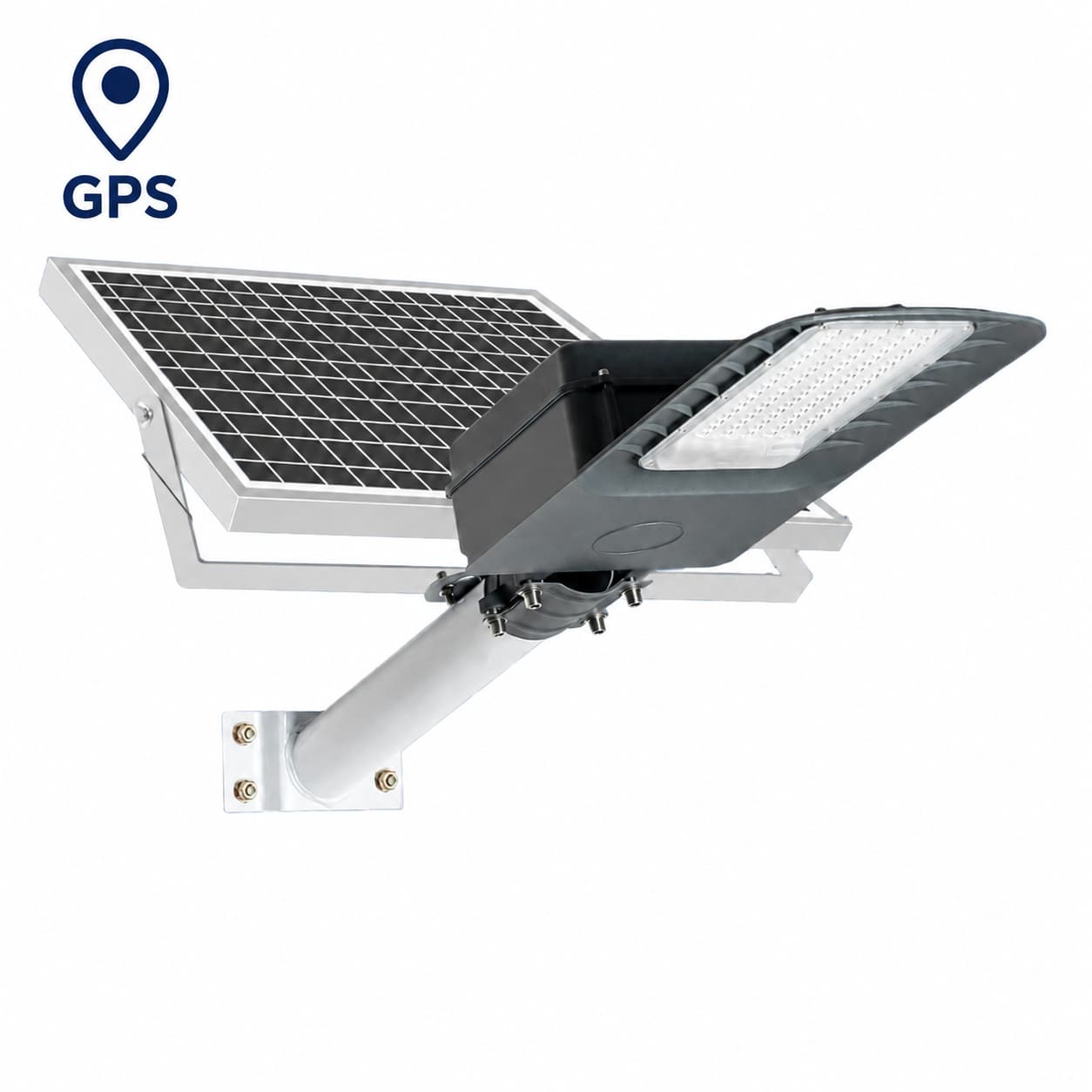
Features global GPS positioning and anti-theft capabilities with a location accuracy of within 0.5 meters. If a light requires maintenance, its exact location can be pinpointed for immediate access; in the event of theft or unauthorized movement, the light can be tracked and located using navigation.
Adjustable Color Temperature
The AI IoT system automatically adjusts color temperature based on weather conditions. Warm light improves visibility in rain or fog, while white light provides clear illumination in good weather, creating safer and more adaptable outdoor lighting for different environments.
Adjustable Brightness
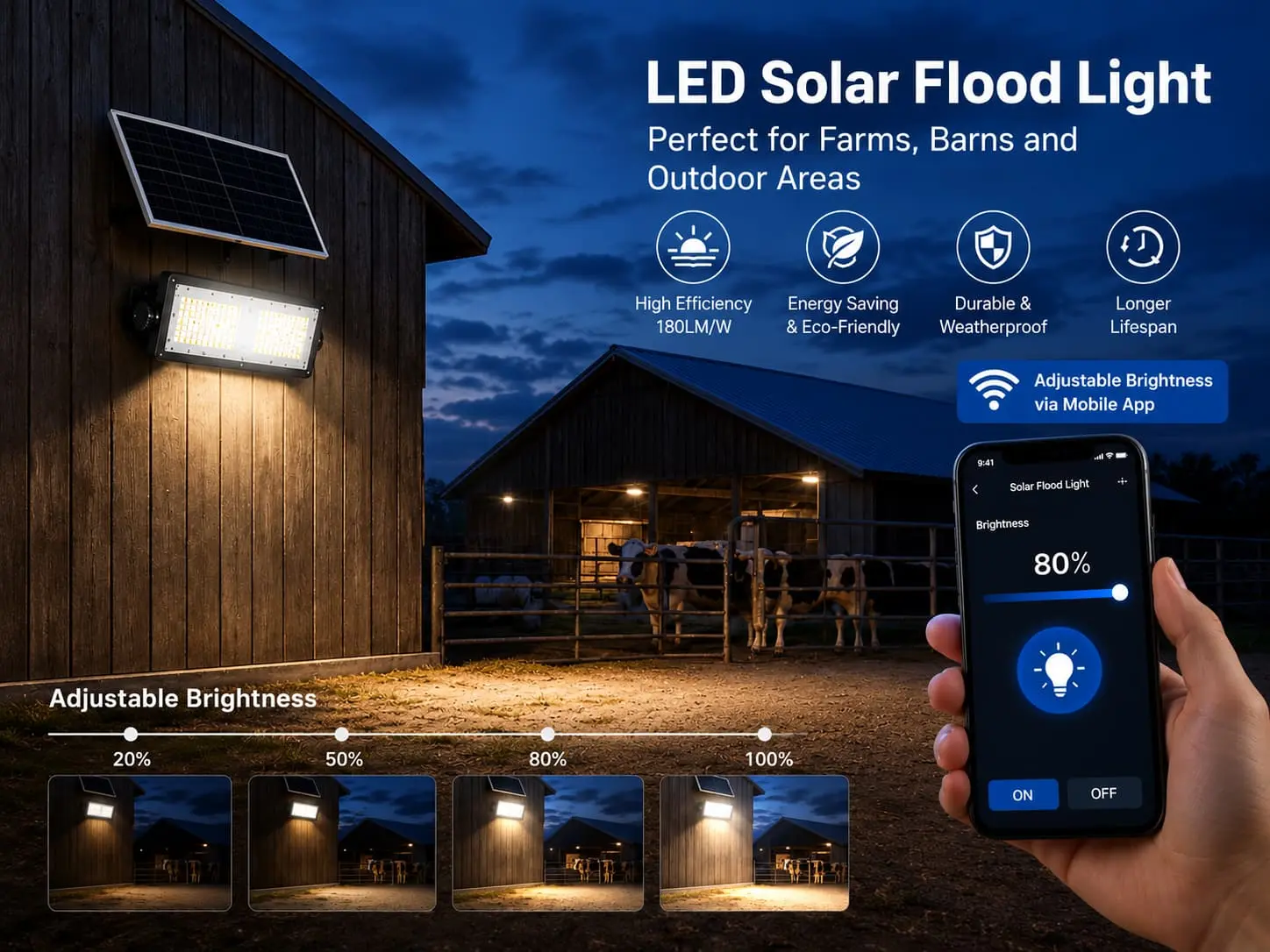
The 50W AI IoT solar flood light allows for one-touch brightness adjustment of all lights according to customer requirements, or the configuration of preset lighting modes. Actual brightness varies with battery charge level; 9,000–10,500 lm is the maximum output at 180–210 lm/W.
High-brightness LED Chips
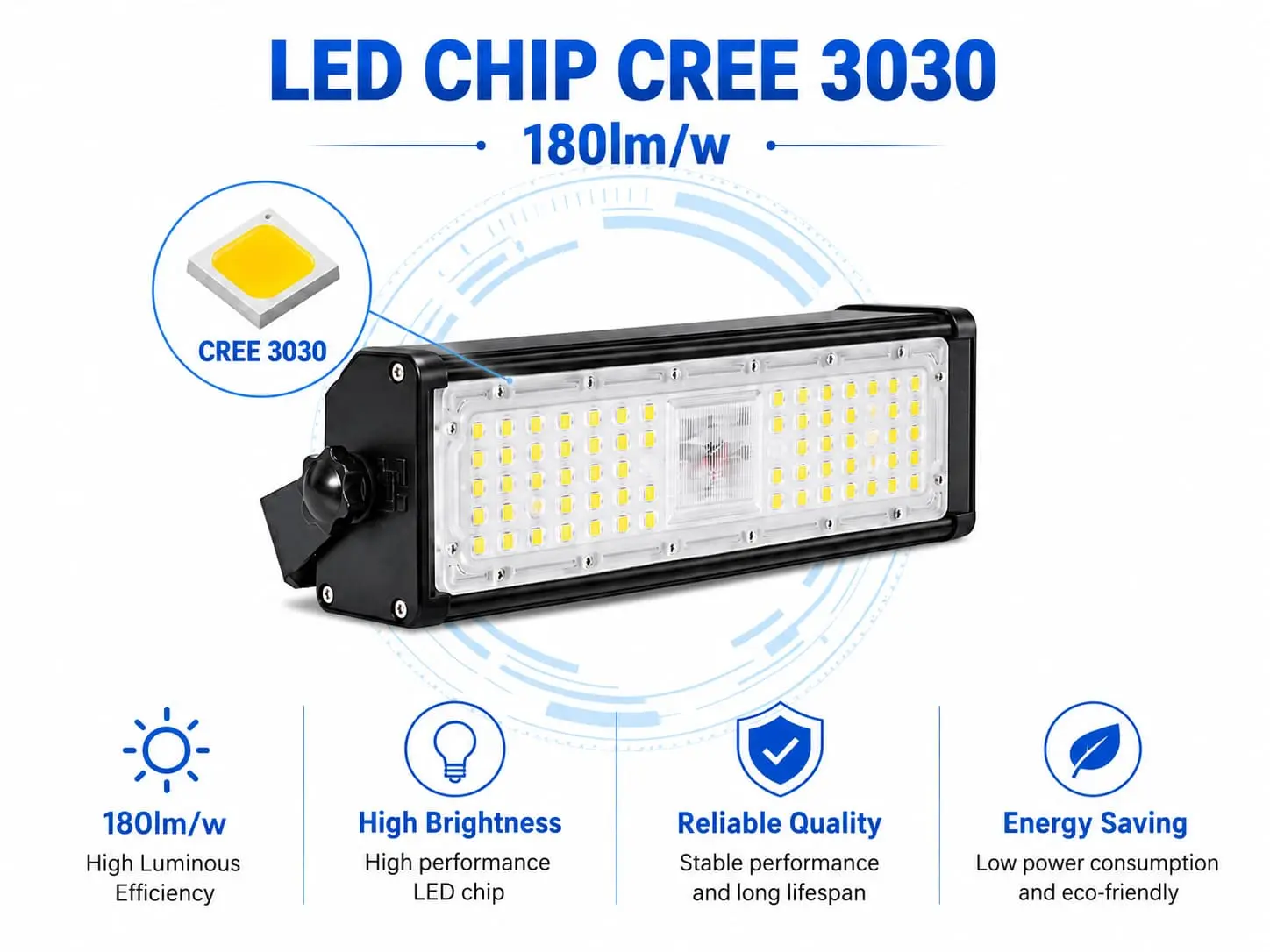
(CREE 3030 LED chip 180~210lm/W)
LED chips are manufactured by Cree 3030; it helps maintain high quality standards and increases the lumens efficiency up to 180 to 210 lm/W.
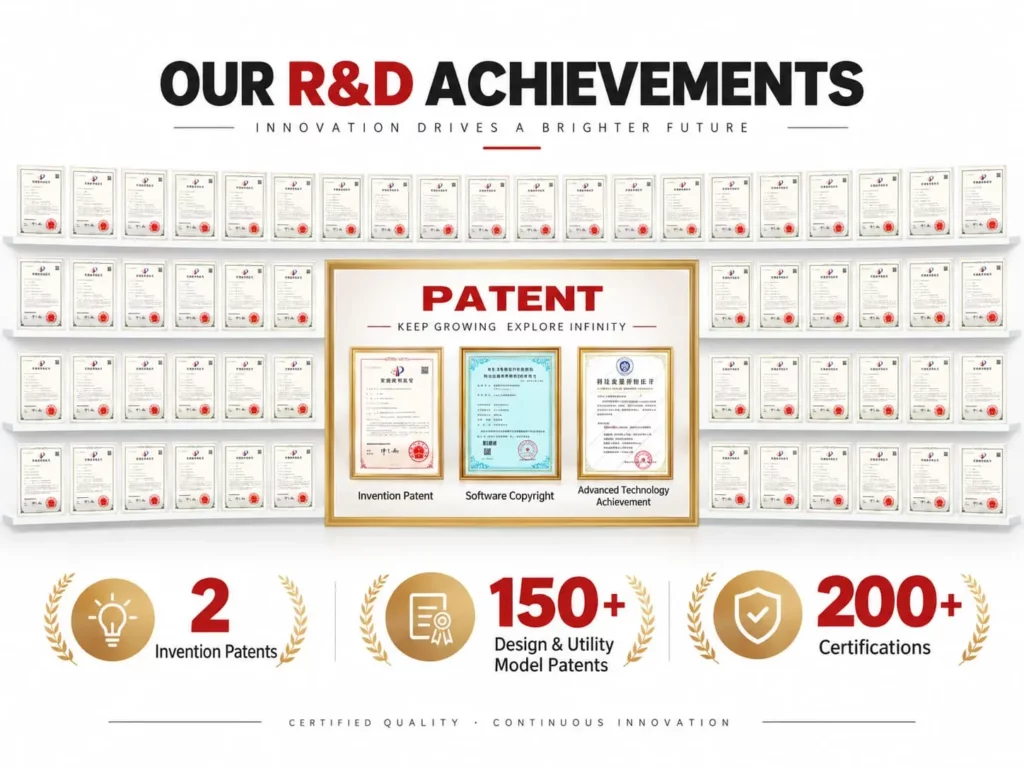
Company Certificates and Patents
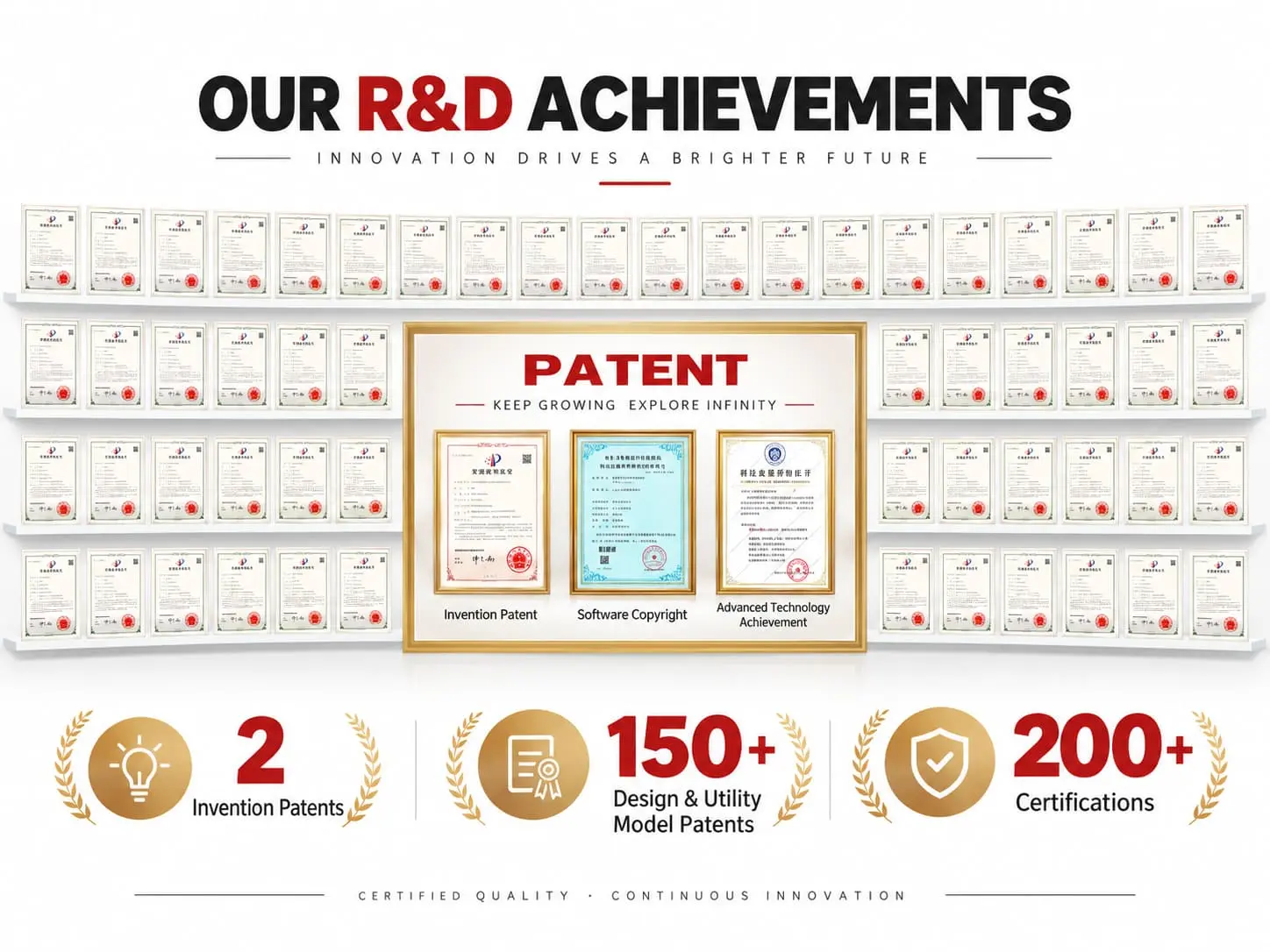
We have patent certificates for our inventions of AI IoT systems, and we are the only organization in the world that has invented AI IoT solar streetlight systems on our own. Our company owns more than 150 design and utility model patents, and our factory holds quality management certificates as well as product certificates.
Functional Advantages
Remote Brightness/Color Temp Control — Adjust anytime without physical presence
AI Smart Scheduling — Auto-optimized lighting strategy, 40% lower O&M cost
Data Visualization — Real-time charts for data-driven O&M decisions
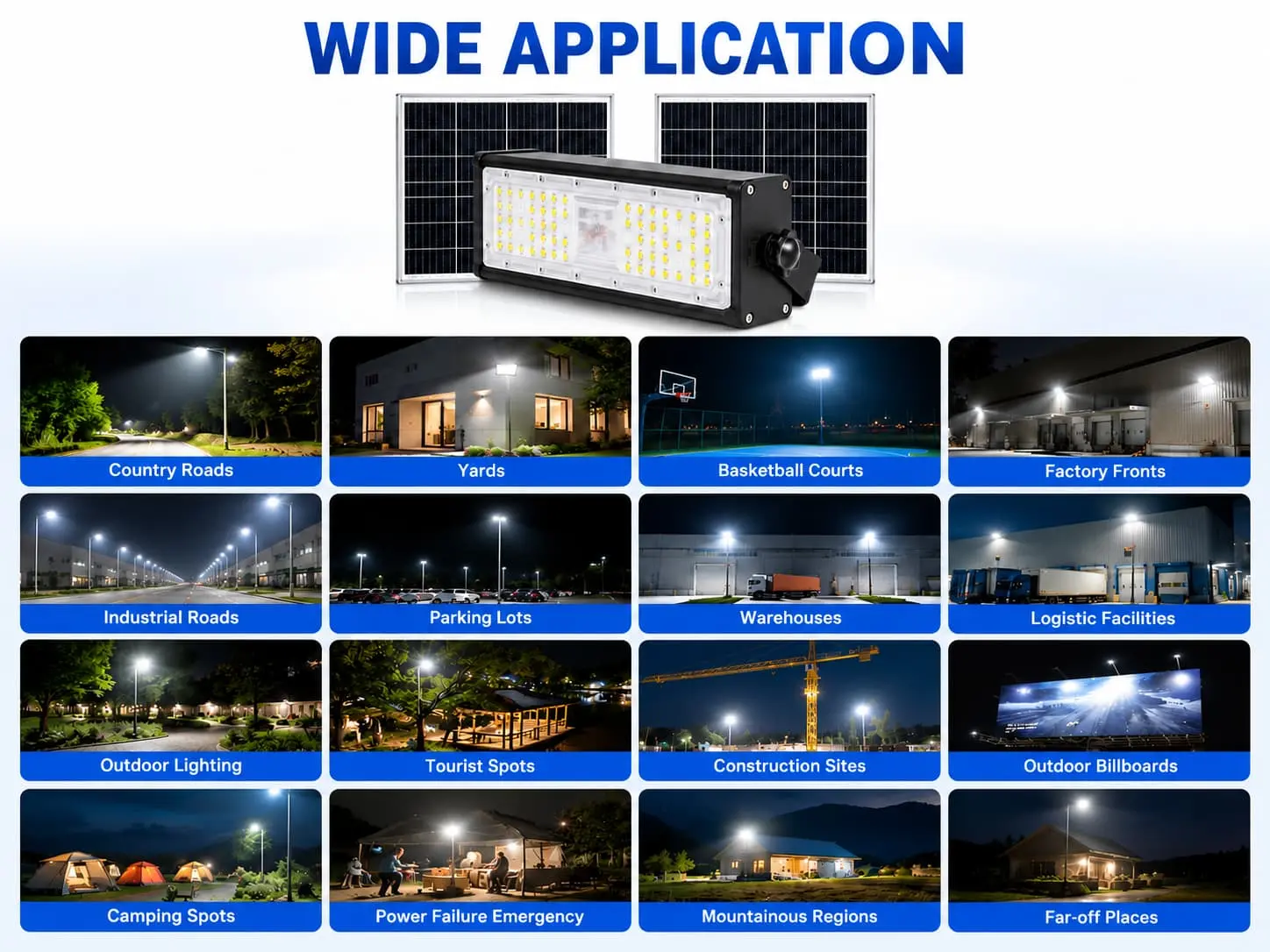
Usage Scenarios For Solar Foodlights
Ideal for use in country roads, yards, basketball courts, factory fronts, industrial roads, parking lots, logistic facilities, warehouses, outdoor lighting, tourist spots, construction sites, outdoor billboards, camping spot
werise AI IoT Smart Solar Flood Light 50W
Brand Name
werise
Model Number
HC-WT2-A50W
Lamp Power(W)
50W
Housing Material
Die-cast Aluminum
Power Supply
Solar
Chip Brand
OSRAM/CREE
Controller
AI IoT MPPT Controller (PC & App Control, Light Control & Remote Control)
Solar Cell
Mono-Si
Lens
PC lens
Beam Angle(°)
80° × 90°
Lamp Luminous Efficiency(lm/w)
180~210lm/W
Lamp Luminous Flux(lm)
9000~10500lm
Color Temperature
3000K-6000K ,AI Adjustable
Adjustable Brightness
Adjustable
Color Rendering Index(Ra)
>75
Certification
CE, RoHS
Lifespan
50,000 Hours
Working Temperature(℃)
-50°C to +60°C
IP Rating
IP65
Lighting solutions service
Lighting And Circuitry Design, solar power
Solar Panel & Battery Specifications
Solar panel
20W 18V Mono-crystalline
Battery
15Ah 3.2V LiFePO4 External Battery Box
Charging time
5-6 hours
Discharging time
10–12 hours per night in time-segmented dimming mode (up to 3 rainy days)
Q1:Is the AI IoT system developed in-house?
A: Yes, the AI+IoT system is 100% self-developed by our company, not sourced from third parties. Full control of core technology with flexibility for customization and upgrades.
Q2:How far in advance can the AI fault warning notify?
A: The system provides 72-hour advance warnings for anomalies, helping customers shift from reactive to proactive maintenance, significantly reducing downtime and maintenance costs.
Q3:Can I remotely control the light brightness via phone?
A: Yes. Through the mobile APP or Web platform, you can adjust brightness, color temperature, switch lights on/off— all remotely without physical presence.
Q4:What installation scenarios are suitable?
A: Suitable for rural roads, courtyards, basketball courts, factory entrances, industrial roads, parking lots, logistics facilities, warehouses, outdoor lighting, tourist attractions, construction sites, billboards, and campsites.
Q5:What is the IP rating? Can it work in harsh weather?
A: Products meet IP65 waterproof rating, dust-tight and water-resistant.Designed for reliable outdoor operation in rain, dust, and changing temperatures.. Stable operation in rain, snow, sandstorms, high/low temperatures.
Q6:How to check real-time device operation status?
A: Through the AIoT management platform (Web/APP), you can view real-time battery level, power generation, LED status, GPS location, and historical data charts.
Q7:What additional value does the AI IoT version offer compared to regular solar flood lights?
A: The AI IoT version reduces O&M costs by 40% through smart scheduling, prevents sudden failures with 72-hour warnings, and reduces site visits via remote control — delivering higher overall value.
Q8:What international certifications do the products have?
A: Products comply with IEC, CE, ROHS international standards, reliable quality, export-ready for major global markets.
Q9:What is the warranty period?
A: Our standard warranty is 3 years. Warranty terms for customized project configurations can be confirmed with our sales team before ordering.
Q10:How to purchase or get a quotation?
A: Please share your project details (wattage, quantity, application), and we will provide a tailored product solution and quotation.
1. The short answer: one housing vs separate components
An all-in-one solar street light puts the panel, battery, LED and controller in a single housing. One unit goes up the pole, and the configuration is fixed — what you order is what you get.
A split solar street light keeps the parts separate: the light head, the solar panel and the battery box are individual components, each sized for the project. Werise’s street lights use separate components. HC-JDSL-02 is named a split system on its own product page. HC-CZSL-39 keeps its battery in a separate external battery box, plug-connected to the lamp body. HC-ZY-01 lists its panel and battery as separate components sized per model.
So the choice is not about which form is “better” in general. It is about how much the project needs to configure — power, panel, battery and pole height — and how the parts are put together on site. This guide compares both forms, then uses Werise’s split systems as the worked examples.
2. What a split system is (Werise HC-JDSL-02)
HC-JDSL-02 is Werise’s split solar street light, and its product page lists every part as a separate, configurable item:
Power models: 400W / 500W / 600W / 700W / 800W, configurable per project.
Solar panel: 18V, 100W / 120W / 150W / 180W / 200W.
Battery: 3.2V / 6.4V / 12.8V / 25.6V LiFePO4, capacity matched to lighting power, operating hours and local sunlight. The spec table lists 6.4V 50Ah up to 12.8V 50Ah by power model.
Controller: AI IoT MPPT control (PC & App, light & remote control).
Colour temperature: 3000K–6000K, adjustable via AI IoT control.
Mounting: pole or wall mounting; mounting height by power model per the spec table (8–13 m).
IP65, 180–210 lm/W, CREE / OSRAM LED, 50,000-hour lifespan, warranty 3–5 years depending on configuration.
The product page states the reason for the separate battery box directly: the external battery design makes inspection, maintenance and replacement more convenient. The panel, battery and LED power can each be configured to suit municipal roads, industrial parks and other outdoor applications.
3. What an all-in-one is
An all-in-one puts the panel, battery, LED and controller in one housing. There is one unit to mount and no wiring between components. The configuration is fixed at the factory: the panel size, battery capacity and LED power are set for that model, and the panel angle is fixed by the housing — so the bracket or arm direction sets the panel orientation, not a separate panel mount.
That form suits projects where the required power is modest and the configuration is standard: one unit, one mounting step, a clean look. Its limit is configurability. A bigger battery or a differently aimed panel means a different model, not a different configuration of the same model.
No Werise street-light model in this guide is presented as an all-in-one. Werise’s CZSL-39 and ZY-01 lines keep the battery as a separate component — CZSL-39’s battery is an external battery box — so a buyer comparing a true one-housing all-in-one against a Werise model should compare the battery arrangement, not just the wattage label.
4. The comparison
All-in-one
Split (Werise HC-JDSL-02)
What it is
Panel + battery + LED + controller in one housing
Head, panel and battery box as separate components
Panel
Fixed to the housing; angle set by the bracket/arm
Separate; 100–200W 18V, sized per project
Battery
Inside the housing, fixed capacity
External battery box; 3.2V / 6.4V / 12.8V / 25.6V LiFePO4, capacity matched to the project
Power range
Fixed per model
400–800W configurable (JDSL-02)
Controller
Varies by model
AI IoT MPPT (PC & App, light & remote control) on JDSL-02, CZSL-39 and ZY-01 — the controller is not the differentiator
Installation
One unit to mount
Three components to mount (head, panel, battery box)
Maintenance
Whole unit comes down for service
External battery box: inspection, maintenance and replacement more convenient (JDSL-02 product page); CZSL-39 battery box is plug-connected for easy maintenance and replacement
Rainy-day backup
Fixed by the model’s battery
Sized per project; CZSL-39 states up to 3 rainy days in dimmed mode — for JDSL-02 confirm before ordering
Werise’s fixed-pair models sit between the two forms in practice: HC-CZSL-39-150W pairs a 70W 18V panel with a 75Ah 3.2V LiFePO4 external battery box (150W, 27,000–30,000 lm, 6–8 m mounting, lighting area 30–50 m²); HC-CZSL-39-100W pairs a 60W 18V panel with a 60Ah 3.2V LiFePO4 external battery box (100W, 18,000–21,000 lm, 4–6 m mounting, lighting area 20–30 m²); HC-ZY-01 pairs panel and battery per power model from 25W to 80W (panel 18V 25–80W; battery 3.2V 20–80Ah; mounting 3–8 m by model). The panel and battery are matched per model, not configured freely — but the battery is still a separate external box, not sealed inside the housing.
5. Which one fits which project
Choose a split system (HC-JDSL-02) when the project needs the parts sized individually: higher power (400–800W), a larger battery, a panel aimed independently of the head, or taller poles. The Guangxi project in section 6 is that case — 12 m poles with two heads, two panels and two batteries per pole, a configuration no fixed unit carries.
Choose a fixed-pair model (HC-CZSL-39 or HC-ZY-01) when the project’s needs match a standard configuration: 100W or 150W with a matched panel and battery, 4–8 m mounting, and the external battery box arrangement. The panel and battery are already matched for the model, so the decision is which model, not which parts.
Choose a true all-in-one (market form) when the project wants the simplest install and the fixed configuration fits the road — and check two things before ordering: how the battery is accessed for service, and whether the fixed panel angle suits the site’s sun exposure. A panel facing the wrong way can lose a large part of its charge, and on an all-in-one the bracket or arm direction is what sets it.
Do not choose on wattage alone. Two “150W” lights can be an all-in-one with a fixed battery and a split system with a configured battery — different systems under the same label.
6. Worked example: a split system on a real project (Guangxi)
The Guangxi industrial access-road project used HC-JDSL-02 Custom AI IoT Split. The case page records: 12 m poles; two 200W LED heads per pole; two 160W monocrystalline panels and two 6.4V 100Ah batteries per pole; AI IoT MPPT controller. Actual operating power is 60W per head against the 200W rating, at 198 lm/W.
That is the split argument in one project: the heads, panels and batteries were each sized for 12 m poles on an industrial access road, and the battery bank per pole (two 6.4V 100Ah packs) is far larger than any single housing could carry. A fixed all-in-one could not be configured this way — the project would have needed a different model, not a different configuration.
7. What to send for a quote
The HC-CZSL-39-150W product-page FAQ states what Werise asks for: the project country/city, road or site dimensions, pole height and spacing, required operating hours, quantity and any special requirements. Add one line for this decision: whether the project needs a split system with configured parts, a fixed-pair model, or — if the site suits it — a true all-in-one form. If the inputs are not settled, Werise recommends from them; do not order on wattage alone.
Two commercial facts that affect planning: there is no MOQ — even a single unit can be customized — and lead time is 10–30 days (factory-confirmed 2026-11-14). Confirm the lead time for the exact configuration before ordering, because a custom battery or panel configuration is not a stock item.
8. FAQ
Q: Is Werise’s HC-CZSL-39 an all-in-one solar street light?A: No. Its battery is a separate external battery box, plug-connected to the lamp body — the product page states this directly. The panel is sized per model (60W 18V for the 100W model, 70W 18V for the 150W model). It is a separate-component design, not a single sealed housing.
Q: Can a split system use a bigger battery than an all-in-one?A: Yes. On HC-JDSL-02 the battery is configurable — 3.2V, 6.4V, 12.8V or 25.6V LiFePO4, capacity matched to lighting power, operating hours and local sunlight. On HC-CZSL-39 the battery is fixed per model (60Ah for 100W, 75Ah for 150W). Battery size is part of the configuration, so compare the battery, not just the wattage label.
Q: Does a split system take longer to install?A: Structurally, yes — the head, panel and battery box are three components to mount, against one unit for an all-in-one. Confirm the installation schedule per project before ordering; this guide states no minute or hour figure.
Q: Do both types use the same AI IoT controller?A: On Werise’s models, yes. HC-JDSL-02, HC-CZSL-39 and HC-ZY-01 all list the AI IoT MPPT controller with PC and App control, light and remote control. The controller is not what differs between the forms — the panel, battery and housing arrangement is.
Q: Which one should I choose for my road?A: It depends on power, battery, pole height and sun exposure, not on the form alone. Send the project country/city, road dimensions, pole height and spacing, required operating hours, quantity and any special requirements, and Werise will recommend the model and configuration. Do not order on wattage alone.
9. Links and CTA
Related reading: What are AI IoT solar street lights?, solar street light wattage guide, solar street light installation guide, solar street light price guide, how to choose solar street lights for municipal and rural roads, HC-JDSL-02, HC-CZSL-39-150W, HC-CZSL-39-100W, HC-ZY-01, Guangxi case and contact us.
Send your road width, pole height and hours per night — we will recommend the model and a lighting layout.
Section 1. The short answer: quoted per project, no fixed price
There is no fixed price list for a Werise solar street light, and this guide does not invent one. Every system is quoted per project, because the price depends on the full configuration — lamp, panel, battery, controller, pole height, quantity and customisation — not on wattage alone. A buyer who asks only “how much is a 100W solar street light” will get a useless answer, from any supplier, because two 100W lights can be entirely different systems. The rest of this guide explains what goes into the quote, so the reader can ask for the right one.
Section 2. The seven cost drivers
1. Wattage and lumens. Lumens are the light output; efficacy (lm/W) is lumens per watt. Cost follows the light output the project needs, not the wattage label. Two verified examples: HC-WT2-A50W is 50W at 180–210 lm/W, maximum 9,000–10,500 lm; HC-CZSL-39 is 150W, 27,000–30,000 lm. A higher-wattage light with low efficacy can cost more and light less than a lower-wattage light with high efficacy.
2. Panel and battery. The energy system is usually the largest cost block after the lamp itself. The panel must recharge the battery in local daylight; the battery must carry the light through the night and through cloudy days, in dimmed mode. Verified matched pairs from Werise product pages: HC-WT2-A50W, 20W 18V panel + 15Ah 3.2V LiFePO4; HC-CZSL-39-100W, 60W 18V panel + 60Ah 3.2V LiFePO4; HC-CZSL-39-150W, 70W 18V panel + 75Ah 3.2V LiFePO4. A bigger panel and battery cost more — and a system quoted with an undersized pair will cost more later, in failed nights.
3. Controller. The AI IoT MPPT controller (PC & App, light & remote control) is stated on the product pages of HC-CZSL-39, HC-CZSL-39-100W, HC-JDSL-02 and HC-WT2-A50W. It adds remote monitoring, batch on/off, dimming and colour-temperature control, GPS positioning and anti-theft on the models whose pages state those functions. Some Werise floodlights use Tuya control instead, over a 4G built-in chip (factory-confirmed 2026-11-14). Controller choice is a cost driver — do not compare an AI IoT quote with a basic-controller quote as if they were the same product.
4. Split vs all-in-one. In a split system the head, panel and battery box are separate components, and each can be sized and customised per project — HC-JDSL-02 is a split system with configurable power models (400–800W), panel 100–200W 18V and battery options of 3.2V, 6.4V, 12.8V or 25.6V LiFePO4. A split system costs more to configure and install than a fixed all-in-one, and it fits projects a fixed unit cannot. Do not price a split system against an all-in-one on wattage alone.
5. Pole height and mounting. Mounting heights from Werise product pages: HC-JDSL-02 at 8–13 m by power model; HC-CZSL-39-100W at 4–6 m; HC-CZSL-39-150W at 6–8 m; the two verified project cases use 12 m poles. Taller poles, dual-head configurations and wall-versus-pole mounting change the hardware and the installation — all of it belongs in the quote, not in the lamp price.
6. Quantity and customisation. There is no MOQ — even a single unit can be customized — and lead time is 10–30 days (factory-confirmed 2026-11-14). Quantity, custom battery or pole configurations and custom optics all move the unit price, so ask for a quantity-based quote for the exact configuration rather than comparing a single-unit price with a bulk price.
7. Shipping, installation and after-sales. Warranty is 3 years for the whole unit and 5 years for core components. Every light undergoes aging testing before shipment (HC-JDSL-02 product page). Shipping, installation and after-sales support are project costs — confirm what is included in the quote before ordering; this guide does not state freight or installation figures.
Section 3. Why wattage alone cannot price a light
Two verified Werise cases make the point. In Guangxi, HC-JDSL-02 heads are rated 200W per head but the case page records actual operating power of 60W per head. At Shenzhen Airport, HC-WT3-A200W heads are rated 200W with a configured operating power of 50W. The same “200W” label covers different energy systems, different battery banks and different operating schedules — so a price quoted on wattage alone is not a comparable price. Ask for the full spec: lamp power and lumens, panel, battery, controller, pole height, dimming schedule and warranty.
Section 4. Worked comparison — verified specs, no prices
Model
Lamp power
Lumens (max, where stated)
Solar panel
Battery
Controller
Mounting height
Warranty
HC-WT2-A50W
50W
9,000–10,500 lm
20W 18V mono
15Ah 3.2V LiFePO4
AI IoT MPPT (PC & App)
Confirm before ordering
3 years
HC-CZSL-39-100W
100W
18,000–21,000 lm
60W 18V mono
60Ah 3.2V LiFePO4
AI IoT MPPT (PC & App)
4–6 m
3 years
HC-CZSL-39 (150W)
150W
27,000–30,000 lm
70W 18V mono
75Ah 3.2V LiFePO4
AI IoT MPPT (PC & App)
6–8 m
3–5 years (by configuration)
HC-JDSL-02
400–800W (configurable)
Confirm before ordering
100–200W 18V (configurable)
3.2V / 6.4V / 12.8V / 25.6V LiFePO4 (configurable)
AI IoT MPPT (PC & App)
8–13 m (by power model)
3–5 years (by configuration)
Note: the HC-CZSL-39-100W lumen total is stated on its product page (18,000–21,000 lm). HC-WT2-A50W mounting height is not stated on its product page.
Section 5. What a like-for-like quote needs
The HC-CZSL-39-150W product-page FAQ states what Werise asks for: the project country/city, road or site dimensions, pole height and spacing, required operating hours, quantity and any special requirements. Send all of it. A quote built on wattage alone is not like-for-like with a quote built on the full spec, and the cheaper of the two is usually the one with the smaller panel, the smaller battery or the shorter warranty — the parts that fail first. Also state the operating pattern: Werise solar lights run 10–12 hours per night in time-segmented dimming mode, not at 100% brightness all night, with up to 3 rainy days of backup in dimmed mode (factory-confirmed 2026-11-14). A quote that assumes full power all night is pricing a different system.
Section 6. How to compare two quotes
Same panel wattage and battery capacity, or the comparison is void. Same controller — AI IoT MPPT with PC/App remote management is not the same product as a basic controller, and Tuya (4G built-in chip) is a third path. Same warranty: 3 years whole unit / 5 years core components, and check whether the quoted warranty is shorter. Same scope: does the price include poles, foundations, shipping and installation, or the lights only? Confirm before ordering. Same dimming schedule: 10–12 hours dimmed, up to 3 rainy days backup — or a different schedule with a different battery. Ask for the model number and the datasheet, not a wattage label. Two “100W solar street lights” can differ in every line of the table in section 4.
Section 7. FAQ
Q: How much does a solar street light cost?
A: Werise quotes per project — there is no fixed price list. Send the project country/city, road dimensions, pole height and spacing, required operating hours, quantity and any special requirements, and Werise will quote the exact configuration.
Q: Why do two 100W solar street lights cost different amounts?
A: Because watts are only the lamp rating. Panel size, battery capacity, controller, LED efficacy, pole height and warranty all differ between two “100W” lights — and those are what the price is mostly made of.
Q: Does a higher price mean a better light?
A: Not necessarily. Compare the full spec — lumens, panel, battery, controller, mounting height and warranty — not the wattage label and not the price alone.
Q: Is there a minimum order quantity?
A: No. There is no MOQ — even a single unit can be customized — and lead time is 10–30 days (factory-confirmed 2026-11-14). Ask for a quantity-based quote for the exact configuration.
Q: What information do I need to send for a quote?
A: Project country/city, road or site dimensions, pole height and spacing, required operating hours, quantity and any special requirements. If full technical data is not available, drawings, site photos or basic project information are enough to start.
Send your road width, pole height and hours per night — we will recommend the model and a lighting layout.
Section 1. What installation involves — and what it does not
A solar street light is an off-grid system: light head, solar panel, battery box, controller and pole. There is no power cable to run to the grid — the Shenzhen Airport case states the project required “solar-powered parking lot lighting without a grid power connection”. There is still a foundation to build for each pole, and the foundation specification depends on pole height and local conditions — confirm before ordering. The AI IoT part is the controller and the platform. The models used in this guide carry an AI IoT MPPT controller (PC & App, light & remote control), and the installation is not finished until the light is visible and controllable on that platform — not when the pole is up.
Section 2. Before anything is installed: the site survey
The survey decides the configuration. The HC-CZSL-39-150W product page FAQ puts it plainly: Werise normally evaluates the project location, road width, pole height, pole spacing, daily operating hours, required illumination level and local solar conditions, then recommends wattage, optics, solar panel and battery configuration. Send those inputs before the configuration is fixed — not after the poles are ordered.
Three survey items buyers most often skip:
Shading on the panel — the panel must stay uncovered and unshaded. A cover on the panel greatly reduces charging efficiency (stated on the HC-CZSL-39 product pages). Check trees, buildings and the pole’s own head for shading before fixing panel positions.
Hours per night and rainy-day backup — Werise solar lights run 10–12 hours per night in time-segmented dimming mode, not at 100% brightness all night, with up to 3 rainy days of backup in dimmed mode (factory-confirmed 2026-11-14). Settle the hours and the backup days in the survey, because they decide the panel and battery size.
What to send Werise — country/city, road or site dimensions, pole height and spacing, required operating hours, quantity and any special requirements (HC-CZSL-39 product-page FAQ). Drawings, site photos or basic project information work if full technical data is not available yet.
Section 3. Poles and mounting heights
Mounting height is set per project, from the model’s own range:
HC-CZSL-39 150W: 6–8 m mounting height (product page).
HC-JDSL-02: 8–13 m mounting height by power model (product page spec table: 400W 8–9 m, 500W 9–10 m, 600W 10–11 m, 700W 11–12 m, 800W 12–13 m).
HC-CZSL-39-100W: 4–6 m mounting height, pole or wall mounting.
Project poles run taller: both verified cases in this guide use 12 m poles — Guangxi industrial access road and Shenzhen Airport parking lot. Do NOT publish a generic pole-height-to-road-width rule, and do not copy a spacing figure from one model to another. The HC-ZY-01 product page shows a 6 m mounting height with 12 m pole spacing only as a reference configuration for that tested luminaire — it is not a general rule, and this guide does not repeat it as one. Spacing is set by a lighting calculation for the project.
Section 4. Panels and battery boxes (split systems)
In a split system the head, the panel and the battery box are separate components, so each is mounted and checked on its own. Panel and battery are matched per model — the pairs below are from each model’s own product page:
HC-WT2-A50W: 20W 18V mono panel + 15Ah 3.2V LiFePO4 external battery box.
HC-CZSL-39-100W: 60W 18V mono panel + 60Ah 3.2V LiFePO4 external battery box.
HC-CZSL-39-150W: 70W 18V mono panel + 75Ah 3.2V LiFePO4 external battery box.
HC-JDSL-02: configurable — panel 100–200W 18V; battery 3.2V, 6.4V, 12.8V or 25.6V LiFePO4, capacity matched to lighting power, operating hours and local sunlight.
The battery box is external on these models. Check its mounting and that it is protected from damage on site. All four models above are IP65 on their product pages. Do not swap a panel or battery between models — the pair is part of the configuration.
Section 5. Controller and app setup
The AI IoT MPPT controller (PC & App, light & remote control) is stated on the product pages of HC-CZSL-39, HC-CZSL-39-100W, HC-JDSL-02 and HC-WT2-A50W. Setup covers on/off, the time-segmented dimming schedule (10–12 hours per night, dimmed — factory-confirmed) and colour temperature, which is AI-adjustable per model: 3000K–6000K on HC-JDSL-02, HC-CZSL-39-100W and HC-WT2-A50W; 2300K–6000K on HC-CZSL-39-150W.
Two limits to keep straight:
Tuya models are a different control path: Tuya connects over a 4G built-in chip (factory-confirmed 2026-11-14). Do not describe a Tuya model as AI IoT, or an AI IoT model as Tuya.
Sensors are customised per project. There are no fixed detection distance, angle or delay figures — if the project needs sensors, confirm the configuration before ordering.
Section 6. Commissioning and the remote-monitoring check
Every light undergoes aging testing before shipment (HC-JDSL-02 product page). On site, commissioning is a platform check, not just a look at the pole. The definition post states the AI management system can monitor battery status, power generation and LED working status — so check all three for every light, plus:
batch on/off, dimming and colour-temperature adjustment work from the PC/App platform;
GPS position is recorded and the anti-theft function is active — GPS positioning and anti-theft are stated on the product pages of HC-CZSL-39, HC-JDSL-02 and HC-WT2-A50W. Do not claim GPS for a model whose page does not state it;
the dimming schedule is running as configured, not at full power all night.
Handover checklist:
each light visible on the platform;
battery, generation and LED status reporting;
dimming schedule running;
GPS position recorded;
remote on/off and dimming tested.
Accept handover only when the checklist passes for every light, not for a sample.
Section 7. Two real installations
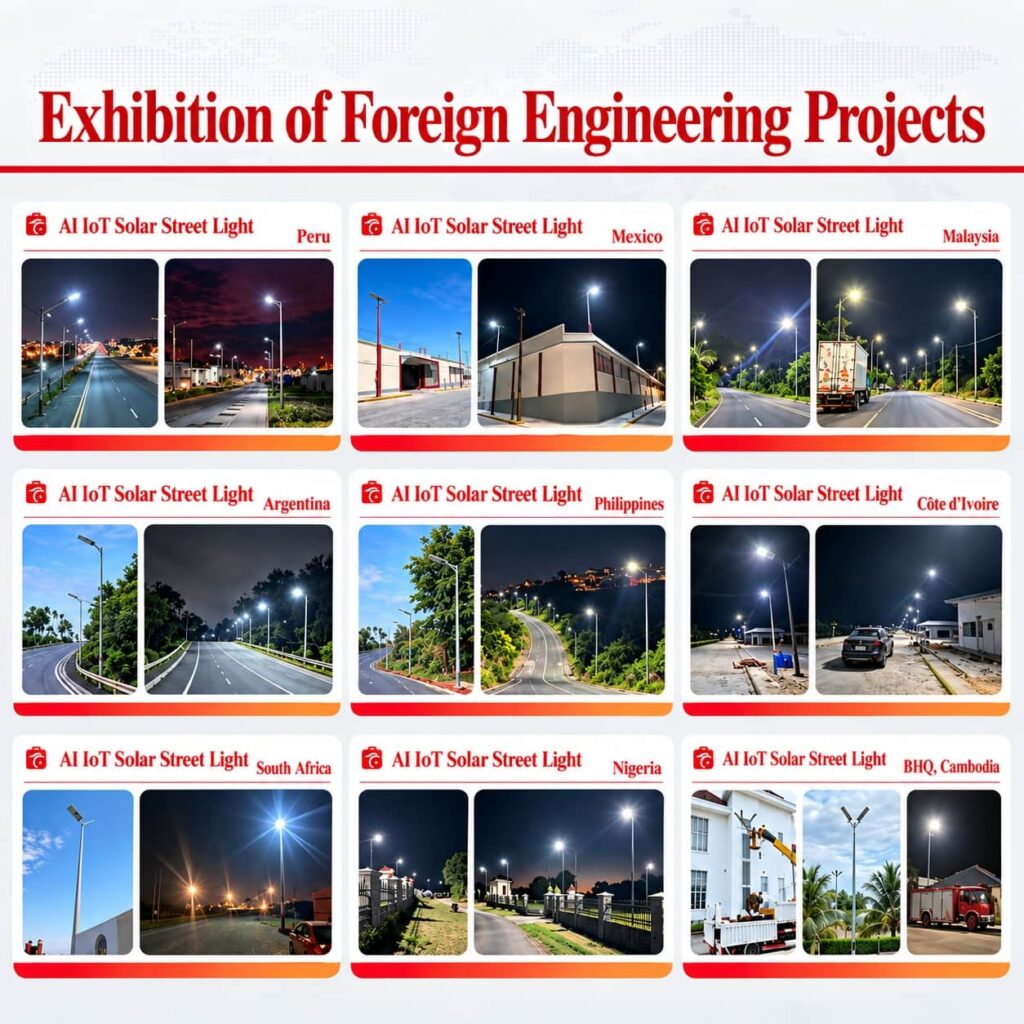
Guangxi — industrial access road (HC-JDSL-02 Custom AI IoT Split). 12 m poles; two 200W LED heads per pole; two 160W monocrystalline panels and two 6.4V 100Ah batteries per pole; AI IoT MPPT controller. The case page records actual operating power of 60W per head against the 200W rating, and luminous efficacy of 198 lm/W. The lesson for buyers: rated watts and operating watts are different numbers, and the panel and battery per pole are part of the answer.
Shenzhen Airport — parking lot, 20,000 m² (HC-WT3-A200W). October 2026 project. 200W rated per head, 50W configured operating power; 6 × 100W monocrystalline panels per pole; 12 × 6.4V 60Ah battery packs per pole; 12 m poles. The case page notes the project required attention to glare and to electromagnetic compatibility for lighting and control equipment used near airport facilities. The lesson: a large site means a large battery bank per pole, and airport-adjacent projects carry checks — glare, interference — that a standard road project does not.
Section 8. What the factory supplies vs what the project provides
Confirm in the quote what is included: lights, panels, battery boxes and controller are the system. Poles, foundations and on-site labour are project items — confirm before ordering; this guide does not claim Werise supplies poles.
Two commercial facts that affect planning: there is no MOQ — even a single unit can be customized — and lead time is 10–30 days (factory-confirmed 2026-11-14). Confirm the lead time for the exact configuration before ordering, because a custom battery or pole configuration is not a stock item.
Section 9. FAQ
Q: How long does a solar street light installation take?
A: There is no fixed figure — it depends on the number of lights, pole height, site access and weather. Confirm the schedule per project before ordering.
Q: Does a solar street light need a grid connection or wiring?
A: No grid connection — the Shenzhen Airport case is solar-powered parking-lot lighting without a grid power connection. Remote monitoring runs through the cloud platform, so confirm the network path for the site before ordering.
Q: What should I check before accepting handover?
A: The checklist in section 6: each light visible on the platform; battery, generation and LED status reporting; dimming schedule running; GPS position recorded; remote on/off and dimming tested.
Q: Can the lights go on existing poles?
A: Mounting is per model — HC-CZSL-39-100W lists pole or wall mounting. Confirm the mounting method and the condition of existing poles for the exact model before ordering.
Q: What if a light stops working after installation?
A: Check the platform first — battery status, power generation and LED working status will usually show whether it is a battery, charging or LED problem. Warranty is 3 years for the whole unit and 5 years for core components. Then contact Werise with the light’s model and its platform status.
Send your road width, pole height and hours per night — we will recommend the model and a lighting layout.
We maintain an efficient production and supply chain system to ensure faster order processing, stable lead times, and reliable shipment schedules. From product preparation to packaging and export delivery, our team follows a clear workflow to help customers receive lighting products on time and keep projects moving smoothly.
We provide OEM and ODM customization services for different lighting applications and project requirements. Customers can customize power, color temperature, housing design, control system, solar panel configuration, battery capacity, packaging, and branding. Our engineering team supports product development from concept to sample and mass production.
We offer complete outdoor lighting solutions for roads, parks, squares, industrial areas, sports venues, rural projects, and off-grid environments. Based on project conditions, we help recommend suitable lighting products, installation plans, solar configurations, and control options to improve lighting performance, energy efficiency, and long-term reliability.