Explosion-Proof Lighting
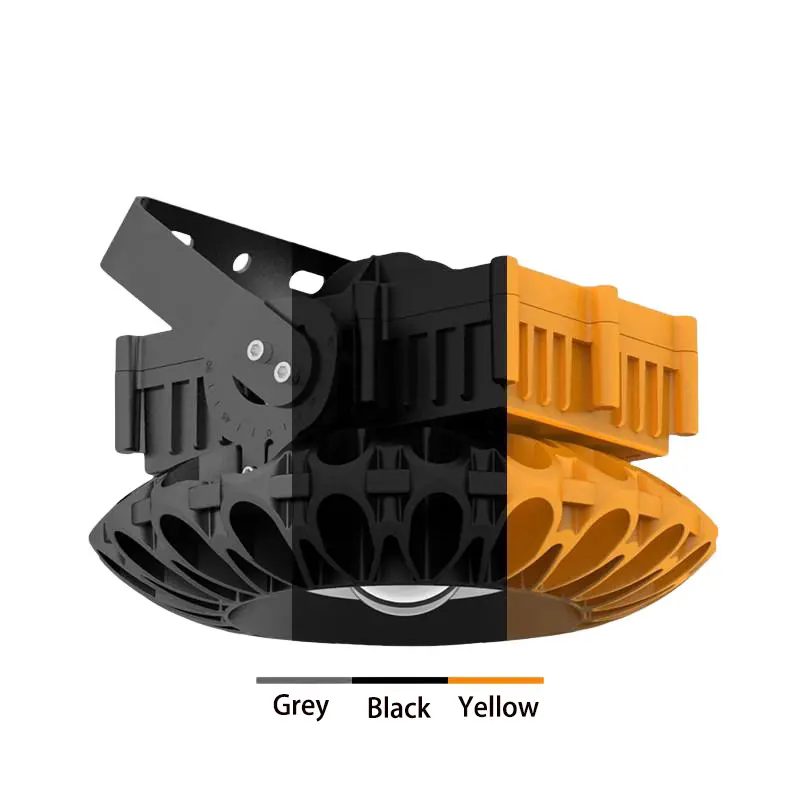
100W Gas Station Explosion Proof High Bay Light HC-HBL-02
Designed for gas stations and hazardous industrial areas, this 100W explosion proof high bay light combines a durable housing, thickened tempered glass lens, efficient 3D heat dissipation, and an adjustable mounting bracket. Its flexible installation design helps direct reliable LED illumination where needed while simplifying installation and long-term maintenance.
Explosion-Proof Lighting FAQs
Answers to common questions.
Solar models use sunlight to charge during the day and light up at night, so they can reduce reliance on grid power and avoid trenching and cabling work in suitable locations. Their separate components are also easier to transport and install than wired systems, which can help lower project installation and maintenance effort. For sites that need a wired option, mains-powered industrial and outdoor lights are available in the same range. Please share your project conditions and we can recommend the right type for your project.
Overall warranty is 3 years, with 5-year warranty for core components (LED light source, battery, controller). After-sales services cover global major markets. providing 24-hour remote support.
Operating temperature: -30°C to +60°C; Protection rating:
IP65-67 (dust and water resistant);
Wind resistance: Grade 12 and above;
Suitable for harsh environments with high salinity, high humidity, and strong UV radiation.
Products have been operating stably in various climate regions including Middle Eastern deserts, Southeast Asian tropics, and African highlands.
Our complete product line covers:
① Municipal roads (arterial, secondary, and branch roads);
② Industrial parks and port terminals;
③ Parks and plazas;
④ Rural roads and remote areas;
⑤ High mast lights and floodlights for large-area lighting.
We offer a full power range from 50W to 2000W to meet different illumination requirements.
Yes. As a manufacturer, we support OEM/ODM projects and bulk orders, including custom sizes, colors, materials and packaging for selected products. Lead time depends on the product, quantity and customization requirements, so please send your specifications and quantity and we will confirm a production schedule for your order.
We continue to develop AI IoT features for our solar lighting models, including remote monitoring and smart control, and will introduce them on selected models as the technology is ready. If AI IoT control is a requirement for your project, please tell us when you send your inquiry so we can recommend models that support it.
IP ratings follow IEC 60529. The first digit (6) means dust-tight. The second digit rates water protection: 5 = low-pressure water jets, 6 = powerful jets, 7 = temporary immersion up to 1 m for 30 minutes. A higher number is not always better — IP67 (immersion) does not prove IP66 (jet) resistance, so look for dual ratings where both matter. For most outdoor fixtures IP65 is the minimum; IP66 suits exposed coastal sites and heavy rain. Most water-ingress failures start at gaskets, cable glands and field-assembled connectors, not the housing. Werise outdoor lights are IP65 or IP66 — for example, the HC-ZY-01 and HC-CZSL-39 are IP65 and the HC-SD-B stadium light is IP66.
Colour temperature describes the look of the light, not its brightness. 2700–3000K warm white suits gardens, planting, entrances and residential areas. 4000K neutral white suits modern facades, concrete, work areas and public roads. 5000–6500K cool white suits security, side passages and industrial sites. Use one colour temperature per area, and 3000K or lower where dark-sky guidance applies. Several Werise models offer adjustable colour temperature — for example, the HC-JDSL-02 covers 3000–6000K and the HC-ZY-01 covers 2300–6000K with AI adjustment — so one model can serve different areas.
Components age at different rates. A typical system lasts 8–15 years: the LED module 50,000–100,000 hours, a LiFePO4 battery 5–8 years (2,000–5,000 cycles), the solar panel 25+ years at 80% output or better, and the controller 5–10 years. Lead-acid batteries last only 2–4 years. Signs the battery needs replacing: the light dims, turns off early, or will not hold charge through cloudy periods. Plan one or two battery replacements over a 15-year project. Werise covers the whole unit for 3 years and core components — LED, battery and controller — for 5 years.
Werise warrants the whole unit for 3 years and core components (LED, battery, controller) for 5 years. Across the industry, typical cover is: solar panel 10–25 years, LED fixture 3–5 years, battery 2–5 years, controller 3–5 years. Almost never covered: gradual battery capacity loss (a battery is a consumable, not a defect), physical damage, and water damage beyond the stated IP rating. Housing and LED are often warrantied separately — read both numbers before ordering.
As a guide, at 140–150 lm/W: 12–15 ft ceilings need 60–100W (9,000–15,000 lm); 15–20 ft need 100–150W; 20–30 ft need 150–240W; 30–45 ft need 240–400W. Do not copy the old HID wattage — a 400W metal halide system draws about 450W including ballast losses, and a 110–200W LED usually matches it. Do not buy the highest wattage for a low ceiling: it creates glare and uneven light. Match fixture spacing to mounting height (about 1:1, never more than 1.5:1). For reference, the Werise HC-HBL-A1 is 100W (13,000–15,000 lm) and the HC-HBL-B1 is 300W (39,000–45,000 lm).
UGR (Unified Glare Rating) measures discomfort glare from luminaires — lower is better. Where people look up, as in warehouses, workshops and gyms, UGR below 19 is the usual target. Typical UFO high bays land at UGR 22–28 in industrial settings and linear fixtures at 19–25. Glare comes from strong centre-beam intensity and unshielded LEDs; it causes eye strain and makes labels and screens hard to read. Reduce it with the right wattage for the height, a narrower beam, deeper reflectors or louvers, and correct mounting height.

Contact Us
AI-Powered Solar Lighting — Smarter Cities, Lower Costs, Cleaner Energy.
