How to Choose a Solar Street Light Manufacturer in China
-
 Werise Engineering Team
- ਨਵੰਬਰ 13, 2026
Short answer: choose a manufacturer you can verify — one with its own factory, export experience, proven test data, and a named contact who answers technical questions.
China makes most of the world’s solar street lights, and the factories cluster in Zhongshan, Yangzhou, and Jinan. That concentration is useful, but it also means a polished catalogue can hide a factory that does not exist. For a buyer sourcing from China, the real test is simple: can the factory show, on a video call or in documents, that it builds the light it sells?
Real manufacturers typically sell through an established brand name and a dedicated sales contact, ship under an established brand, publish datasheets and test reports, and can answer questions about the LED chip, battery, controller, solar panel, certification, warranty, and after-sales support.
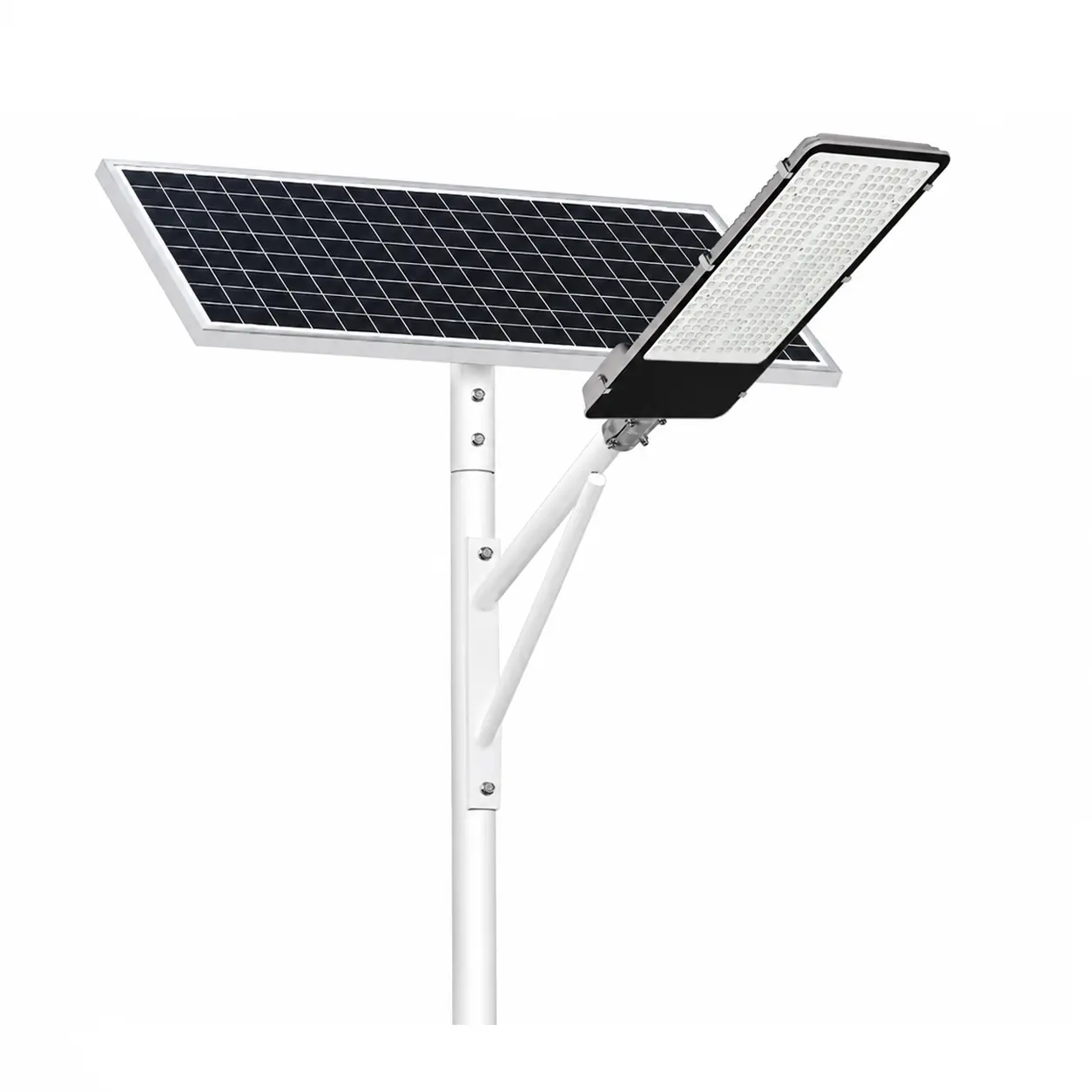
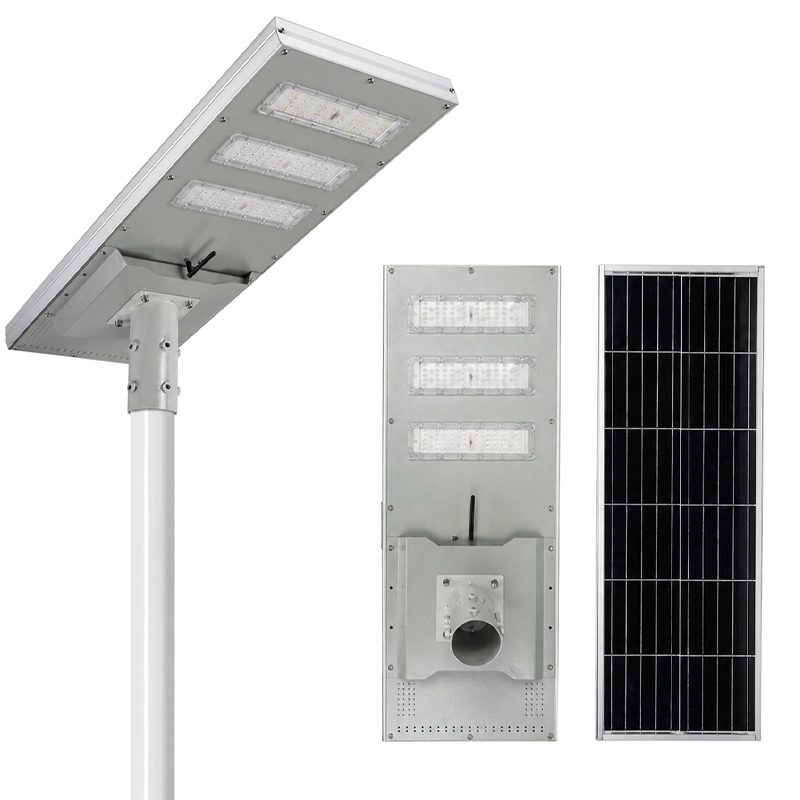
“Solar street lights” are the focus here — all-in-one, split, and post-top (garden-style) solar powered street light models — rather than mains powered LED street lights.
1. Start with four checks, not a ranking
There is no official ranking of solar street light manufacturers in China. Shortlists published by sourcing platforms can be used as a start, but treat them critically: some are based on advertising. Use the four checks below to shortlist your supplier and ask for evidence for each one.
| What to verify | How to verify it | Why it matters |
|---|---|---|
| Does the factory exist? | Business license, factory address, live video call, and photos of production lines, finished goods warehouse, and test bench. | Trading companies cannot show them. |
| Is the product certified? | CE / RoHS / ISO 9001 for the factory, plus product test reports (IES LM-79 if available) and the product’s own certification. | Without certification, the port or project buyer can reject the shipment. |
| Is it an export-ready manufacturer? | Share an FOB list, an export history, and the trade terms (FOB or CIF), plus a checklist of shipping marks and documentation. | An export-ready manufacturer speaks in Incoterms and documentation, not generalities. |
| Can it meet the exact specification? | Datasheet details, factory witness testing, samples, and proof of lead time and re-order reliability. | Structural deficiencies like solar panel size, battery capacity, controller algorithm, and warranty terms cause failures after installation. |
2. What the factory should show you
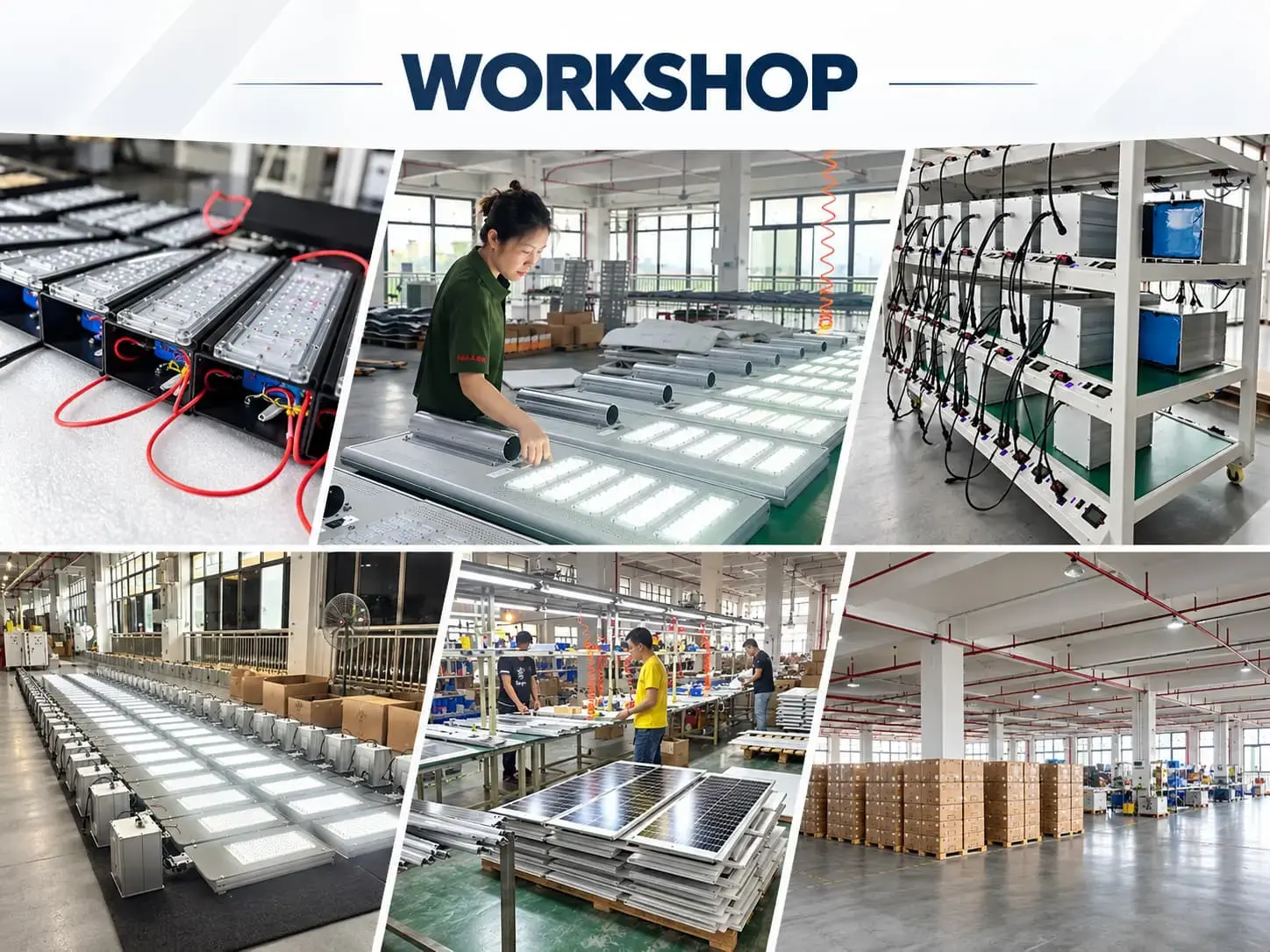


Ask for a short evidence pack tied to the exact model you plan to buy:
- The factory itself. Production lines, aging-test equipment, and warehouse. A video call from the floor beats a brochure. Ask how long a typical order takes from deposit to shipment.
- Test evidence. Test reports (IES LM-79 or similar, if available), a one-to-two-week sample run, and the factory’s own quality inspection process.
- After-sales history. Warranty terms, spare parts supply, and how failures are handled in your time zone.
- Specification checks. Ask about solar panel, battery, controller, certification and warranty terms for your specific configuration, with a named engineer to answer technical questions.
- Case references. Completed projects in countries similar to yours, with product models you can verify.
Werise’s process is to share production, test, and after-sales documentation before an order is confirmed, and to keep a named engineer on the project after delivery is confirmed.
Ask about production lead time and test availability when you make the inquiry so delivery timing can be confirmed before deposit payment. Also ask about the contract terms for claim handling, to confirm how products are handled under warranty.
3. Questions that separate a manufacturer from a trader
- Who owns the factory, and where is it? Can I see the production floor on a video call?
- What is the factory area and how many people work there?
- Which products are made in-house (light housing, pole, controller, solar panel, battery) and which are outsourced? What test equipment do you have?
- What are your best-selling models, and how many units have you shipped to my region?
- Who is my named contact, and which engineer answers technical questions?
- Can you share a datasheet, IES file, and test report for the exact configuration I need?
- What are the warranty terms, and how do you handle a warranty claim in my country?
- What is your lead time from deposit to shipment, and how do you handle a re-order?
- Can I order a sample first, and what is the sample fee and lead time?
- What is your production capacity during peak season, and what is the minimum order quantity (MOQ)?
A manufacturer answers these with documents and dates. A trader answers with general reassurance.
4. Werise as a manufacturer: the checkable facts
Werise is an AI IoT solar lighting manufacturer based in Zhongshan, Guangdong, China — one of the largest manufacturing centres for solar street lights in China. The company uses factory-direct sales: the product is made and shipped from its own factory, which is how price and lead time are controlled.
| Fact | हम उठे |
|---|---|
| Founded | 2010 — 16+ years |
| Location | Zhongshan, Guangdong, China |
| कारखाना | 50,000 m²; 300+ employees |
| Export coverage | 100+ countries |
| Certifications | CE, RoHS, ISO 9001; 200+ product certifications, including explosion-proof certification |
| Intellectual property | 2 invention patents, including ZL 2023 1 0123003.3 for an IoT-based wireless lamp control device and system (granted 2024); 150+ design & utility model patents |
| Product range | Solar street lights, solar flood lights, solar garden lights, LED street lights |
| Flagship products | AI IoT lighting, AI IoT solar street lights and flood lights |
| Applications | Industrial lighting, outdoor lighting, landscape lighting, non-standard customization, municipal engineering, rural revitalization solar products, factory intelligent lighting energy-saving retrofits |
| Service model | Factory-direct sales + OEM/ODM customization |
| Specialisation | AI IoT solar street lights with remote monitoring, remote control, and GPS anti-theft tracking |
| Parent company | Highcoss — Werise is the lighting brand of Highcoss |
| संपर्क | Viki — vikihighcos@gmail.com — WhatsApp +1 213 815 7878 |
| China contact | Ms. Ling — phone/WeChat +86 15876784659 |


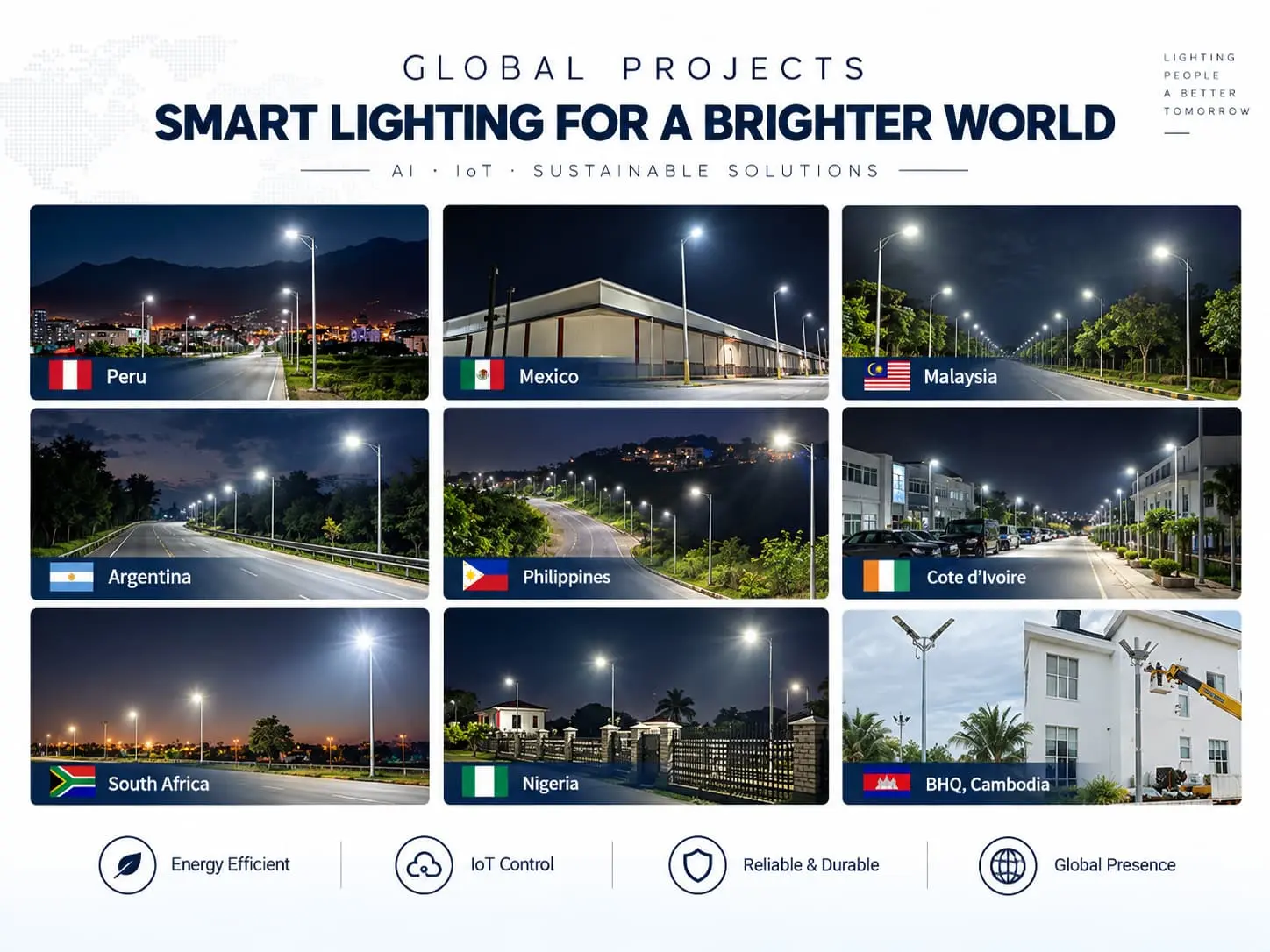


Werise holds CE, RoHS and ISO 9001, with 200+ product certifications including explosion-proof certification. Other certificates — for example CQC, UKCA, SNI or TISI — are examples of what to ask a factory about for a specific market; they are not certificates Werise is claimed to hold here.
Two model examples, with figures from their product pages:
- HC-JDSL-02 — AI IoT split solar street light with MPPT controller, PC/APP control, 3000K–6000K CCT range, IP66 rating, and a 5-year warranty.
- HC-CZSL-39 — AI smart city street light, CREE SMD 3030 / 5050 LEDs, 150 lm/W or higher, NEMA 7-pin photocell socket for smart city controls, IP66, and a 5-year warranty.
Those figures describe those models only. Confirm the figures for the exact model and configuration you plan to buy.
5. A practical path: from shortlist to order
- Build a shortlist of 3–5 manufacturers from sourcing lists, trade platforms, and referrals.
- Send the same enquiry and request a datasheet, test report, and warranty terms for the exact model.
- Check the factory: video call, business license, and evidence pack.
- Order a sample to confirm the configuration and quality.
- Confirm the contract terms, including payment, shipping terms, delivery date, and warranty handling, before deposit payment.
For the roadside decision itself — municipal vs. rural roads, coverage, battery autonomy — see How to Choose the Right Solar Street Light for Your Road.
Send your site plan and project requirements through the contact page for a model recommendation. You can also reach Viki directly at vikihighcos@gmail.com or on WhatsApp +1 213 815 7878.
FAQ
Who are the best solar street light manufacturers in China?
There is no official ranking. The manufacturers that appear most often in sourcing shortlists are the ones that can show a factory, export history, and third-party test results. Start with that evidence, then shortlist by your own criteria.
How do I verify a solar street light factory in China?
Ask for the factory name and address, a live video call from the production floor, CE / RoHS / ISO 9001 certificates, and project references in your region.
Is it better to buy from a manufacturer or a trading company?
A manufacturer controls production, quality, lead time, and customization directly, and can usually offer a better price because there is no middleman.
What should I ask before ordering solar street lights from China?
Confirm the exact model and configuration, the datasheet and test method, the warranty terms for the battery and controller, the payment terms, and the delivery and after-sales process.
Does Werise support OEM/ODM and engineering projects?
Yes. Werise is a manufacturer supporting OEM/ODM projects for distributors, wholesalers, engineers, and project buyers. Send your site plan and project requirements through the contact page for a model recommendation.
How much does a solar street light cost per unit?
(indicative market ranges, 2026 — request a quote for exact pricing) Market ranges vary widely by tier. Factory-gate prices run roughly $29–$2,500 per unit: entry 15–40W models $29–$100; commercial mid-range 40–100W $100–$400; premium municipal 100–300W and above $400–$2,500. By wattage, typical bands are 30W $150–$250, 60W $250–$450, 100W $450–$800, 150W $800–$1,200. Poles, foundations, shipping and installation typically add 30–50% — many factory quotes exclude the pole entirely — and installed cost per pole is often $1,500–$6,000 all-in. These are market ranges, not a Werise quote: send your wattage, pole height and quantity for an exact price.
What is the difference between OEM and ODM?
OEM: you bring a mature design, drawings and specification; the factory builds exactly to your blueprint under your brand. It needs strong in-house R&D and suits premium differentiation or unique certification requirements. ODM: you modify the manufacturer’s existing proven platform — appearance, power, battery, smart features — for faster market entry and controlled R&D cost; it suits most distributors and project contractors. The customisation ladder, fastest and cheapest first: private-label branding, specification changes to an existing series, solar system sizing, then new housing and tooling (longest and most expensive). For road projects, a good factory produces the calculation showing the target lighting class for your geometry — that is what a tender asks for.
Which certificates do I need to import solar lights into the EU or US?
EU entry typically needs CE (EMC + LVD) and RoHS. The US needs FCC and UL/ETL listing for the product category — UL 844 for hazardous locations. ISO 9001 covers the factory quality system, not the product. For other markets, ask a factory whether it holds, for example, PSE (Japan), CCC (China) or IECEx/ATEX for hazardous locations — these are examples of what to ask a factory for, not certificates Werise is claimed to hold here. Always ask for the certificate for the exact model: a factory-level ISO 9001 certificate does not prove a specific luminaire is certified. Werise holds CE, RoHS and ISO 9001, with 200+ product certifications including explosion-proof certification.
What information should I send to get an accurate quote?
Send: product type and application (road, area, facade, warehouse, off-grid compound); road width and pole height; quantity, and whether it is a one-off project or a repeating range; required lux or lighting class, or the tender clause; local sunshine and rainy-season data (or the city name); autonomy days required; and any OEM/ODM brief (logo, packaging, housing changes). A good factory replies with an FOB price, lead time and datasheet, usually the same day, and marks up what an existing series already meets versus what needs a production change or tooling. You can send these details through the Werise contact page or directly to Viki at vikihighcos@gmail.com.