How to Choose the Best Stadium Lights for Sports Facilities and Large Venues
Learn how to compare stadium lighting designs for illuminance, uniformity, glare, cameras, controls, commissioning and long-term maintenance.
Learn how to compare stadium lighting designs for illuminance, uniformity, glare, cameras, controls, commissioning and long-term maintenance.
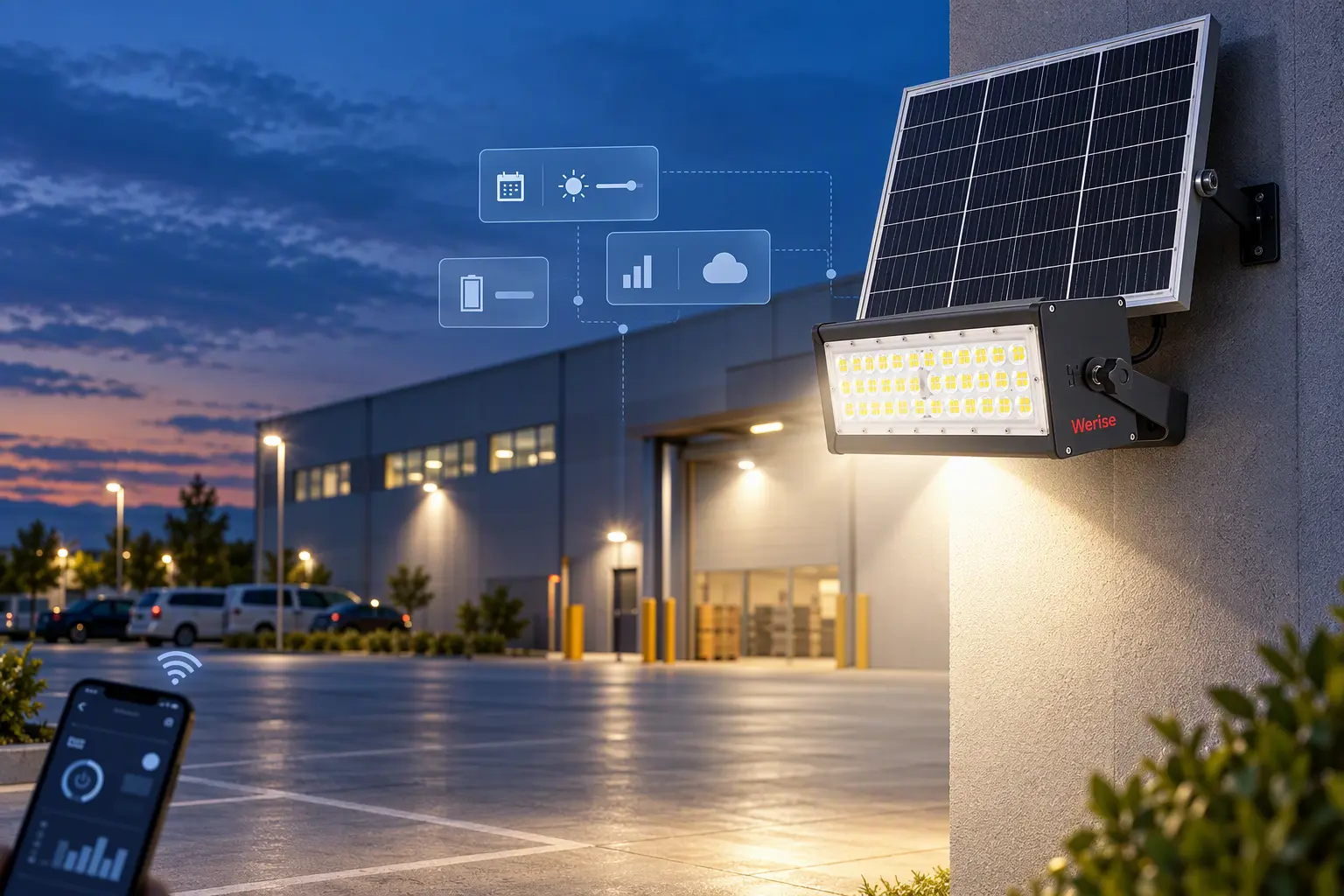
Smart solar flood lights are easier to specify when a buyer treats them as a lighting system rather than as a lamp with an app added later. The solar panel, battery, LED fixture, controller, sensors, network path, and management interface must work together for the intended site. For example, an outdoor solar flood light over a warehouse yard or car park still has to survive weather, charge on short winter days, and switch on reliably at dusk — the app alone cannot do that. For a first project, the practical question is not simply whether a flood light is “smart.” It is whether the chosen system can provide the lighting output, control method, operating schedule, and maintenance visibility that the site requires. Our Tuya Solar Flood Lights are positioned for this kind of project discussion, while the final configuration still depends on the application and site conditions. What makes a solar flood light smart? A conventional solar flood light stores energy during the day and powers the LED fixture after dark. A smart solar flood light adds a management layer around that basic energy cycle. Depending on the selected product and project configuration, the management layer may allow an operator to view status, change settings, schedule operation, or receive an alert. Werise describes AI and IoT solar lighting with remote monitoring, intelligent scheduling, and fault warning. It also describes Web and mobile APP access for functions such as brightness, color-temperature, on/off, and selected equipment control. These statements describe supported system capabilities; they are not a promise that every model or every project includes every function by default. Tuya is therefore best understood as the control platform used in a configured lighting solution. It does not replace the solar panel, battery, LED fixture, or mounting hardware. It adds the interface through which those parts are controlled and monitored. Which project inputs should be defined first? A reliable specification starts with the site, not the catalog. Record the area that needs illumination, the use of the site at night, and the conditions that affect performance. For each location, collect: The application, such as a yard, parking area, warehouse perimeter, park, access road, or industrial site. The target lighting area and the locations where fixtures can be mounted. The desired operating schedule, including full-brightness periods and any dimming periods. Solar exposure, shading, local weather, and the position of the panel. The required control method, such as local control, Web access, mobile APP access, or scheduled operation. The people who need access to the system and the actions each person should be allowed to perform. Any need for status monitoring, fault alerts, GPS identification, or remote firmware updates. The installation method, cable constraints, wall or pole conditions, and maintenance access. These inputs help separate a genuine smart-lighting requirement from a request for a basic solar flood light. How does Tuya solar flood light control fit into the lighting system? In a configured Tuya solar flood-light system, the controller connects the lighting hardware with the user’s management interface. The interface may be a Web dashboard, a mobile APP, or both. The Tuya smart lighting category includes other networked products, so the selected product should be tied to the exact product record, model number, and control scope. For a commercial or industrial site, the value of the management layer is visibility and repeatable control. That value depends on stable connectivity. Those requirements need to be defined in the project plan. What should buyers verify about the product itself? The control platform is only one part of the decision. Confirm the fixture, solar module, battery, control function, expected operating pattern, and installation requirements. The Werise product 100W Tuya Smart Solar Flood Light HC-WT3-A100W is a useful check for the standard information that should be visible on a product page. A related example is the 100W Tuya Smart Solar Flood Light HC-WT3-A100W. The product page lists a 100W lamp, a mono-crystalline solar cell, a LiFePO4 battery, Tuya PC/APP control, adjustable brightness, adjustable color temperature, and pole or wall mounting. Verified on the product page for the HC-WT3-A100W (100W): Tuya app control provides remote on/off, adjustable brightness, adjustable colour temperature from 3000K to 6000K, and timer/schedule control; the product page also lists 21,000 lm luminous flux, 210 lm/W efficiency, CREE 3030 LED chips, IP65 and a 3-year warranty. Sensor detection range, angle and delay are customizable to project and customer requirements. Ask for the exact product record that will be quoted. Check that the following items match the project requirements: The model number and intended application. Solar panel and battery configuration. Controller and supported control functions. Mounting method and mounting height. Operating temperature and enclosure requirements. Beam distribution and target coverage. Available communication and user-management options. Required documents, samples, and acceptance criteria. If a requested function is important, write it into the quotation or technical confirmation rather than relying on a generic page statement. How should a first Tuya solar flood-light project be evaluated? A simple evaluation sequence reduces avoidable changes later. First, describe the lighting task in plain language. For example, a buyer may need scheduled lighting for a yard, or scheduled lighting with a sensor for an access area. Second, define the operating pattern. State when the lights should run, which periods need full brightness, and which periods can be dimmed. Third, confirm the energy and installation conditions. The panel position, available sunlight, battery capacity, cable route, and wall or pole constraints affect the quoted model. Fourth, select the control scope. Decide whether the project needs one-light control, group control, scheduled operation, or status monitoring. Fifth, test the proposed configuration before the full order. Use a sample, demonstration, or documented test to check output, control behavior, and the information that the management interface displays. Finally, define handoff data. The supplier and buyer should agree on model lists, device names, user permissions, and the process for handling faults, changes, and replacements after installation. Which claims require extra project confirmation? Smart-lighting language can sound broader than the evidence behind it. Treat several claims as project-confirmation items: “Remote monitoring” should identify what status is visible and through which interface. “Fault warning” should identify the event types, notification method, and applicable product or products. “Tuya control” should identify the supported controller, account setup, network route, and functions that continue when the network is unavailable. “Camera integration” or other external-device integration should be treated as a scalable project scope, not as a standard function. Numeric performance, certification, warranty, lead-time, and environmental claims should be tied to a named model and supplied documents. This discipline protects the buyer from selecting a system based on a broad marketing phrase that does not describe the quoted configuration. When is a smart solar flood light a good fit? A Tuya-powered solar flood light is a reasonable candidate when the project needs independent solar power and also benefits from repeatable control. The control value comes from the management layer. A basic solar flood light may be enough when the site is small, the schedule is fixed, local access is simple, and status monitoring is not a priority. A Tuya-powered solar flood light is also a good candidate for sites with network constraints, provided that they are considered in the project plan. What should be included in the supplier handoff? Before requesting a final quotation, prepare a short project pack containing the site location, application, mounting conditions, operating schedule, required control scope, and expected operating environment. We can use that information to review the control architecture, identify which functions need product confirmation, and provide a project-specific quotation. Related reading: for motion sensors, dimming and energy saving, see How Motion Sensor Lights Save Energy. Tuya Solar Flood Light FAQs How do I pair a Tuya solar flood light with the app? Add the light in the Tuya app as a new device, put it in pairing mode as the quoted model’s instructions say, and connect it to your account and network. Once paired, the HC-WT3-A100W page confirms Tuya app remote on/off, brightness, 3000K-6000K colour temperature and timer control. The HC-WT3-A100W connects to Tuya via 4G with a built-in chip. Confirm before ordering — the HC-WT3-A100W product page does not give pairing steps. Before ordering, ask for: the pairing procedure and the conditions that close the pairing window, the account setup, and the network route. Once paired, the product page states that Tuya control provides remote on/off, brightness, colour temperature and timer control through the Tuya app. Does the light still work if the network is down? No: app remote control needs the network, so it will not work while the network is down. Typically, as a guide, a solar light may still switch on locally on its stored schedule or at dusk, but the page does not state which functions, if any, continue locally for this model. Confirm before ordering — the product page does not state which functions continue locally without a network. Ask which sensor behaviour, if any, continues locally if the network or app is unavailable. How far away can I control the light from the app? There is no fixed remote-control distance: Tuya app control works through the network, so you can control the light from the app wherever you have network and app access, not within a stated local range. The product page does not state a remote-control range. Confirm before ordering the light’s behaviour for the exact model if you need offline or local control.
Choose solar flood light brightness by task, lumens, lux, beam spread, mounting height and site coverage—without relying on a generic lumen-area chart.
GPS tracking helps locate solar street lights, flag unusual movement, and support theft investigations and asset recovery.
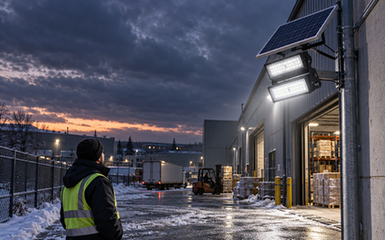
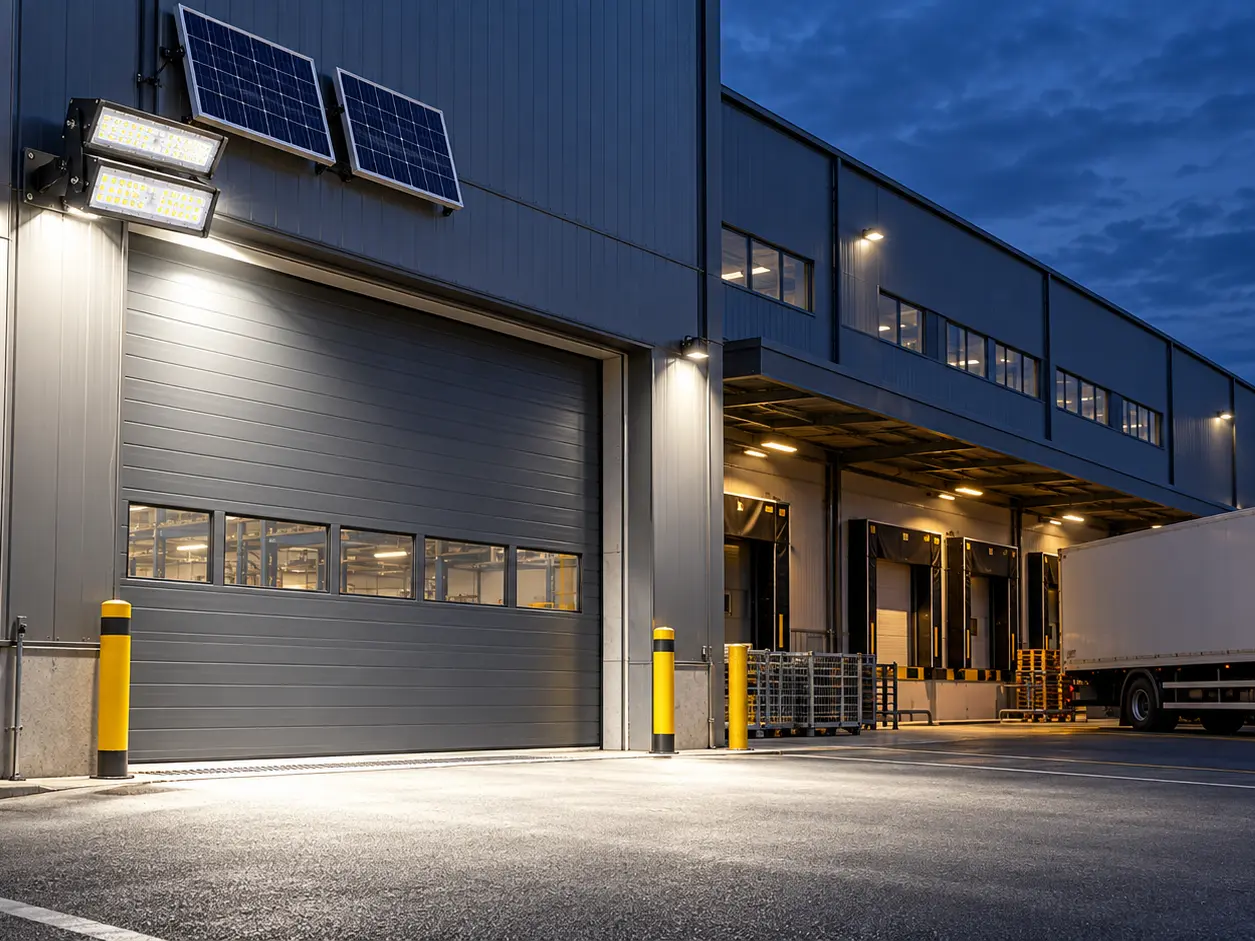
One December afternoon, darkness reaches a warehouse yard before the day shift has gone home. The solar flood light comes on. Near dawn, the supervisor sees that it has not behaved quite as it did in July. That does not prove a fault. July simply supplied a more generous charging day. That is the awkward truth behind winter sizing. The panel gets a different day while the lamp is asked to cover a different night. Add a low sun, a roof edge, three grey days and perhaps some snow, and the comfortable summer margin disappears. Planning for winter means planning for autonomy across those cloudy days, not for a single clear afternoon. Winter Sun Hours and Solar Flood Light Charging On a site visit, I like to stand beside the proposed panel position and look south, east and west before looking at a product sheet. In summer, the sun may clear the workshop roof early. In winter, it can sit behind that same roof well into the morning. A pole, tree or stack of containers that seemed harmless in June can take away a useful part of a December charging window. The seasonal reason is simple geometry. Across many middle latitudes, a shorter winter day also brings more slanted sunlight. Cloud and other atmospheric conditions further reduce the direct beam. To somebody crossing the yard, the afternoon may look reasonably bright. The panel can tell a different story. Cold by itself is not the villain. Photovoltaic modules can work efficiently in cold weather. Ice, snow, weak exposure and the long night make the job awkward, with a different mix on every site. One runtime on a brochure cannot settle winter performance. Before giving an answer, we need the place, panel direction, shadows, lighting schedule, battery condition and the poor-weather sequence being planned for. Runtime comes out of that brief. It cannot travel unchanged from one country to another. Our AI IoT solar flood light range brings the panel, LED flood lamp and control system into one project. It still needs somebody to decide which hours matter. Winter Site Checks Around the Mounting Point The best time to spot a winter shadow is, unsurprisingly, winter. When that visit cannot happen, take photographs from the proposed panel position through the day. Put nearby roofs, trees and equipment on the drawing, then add direction and tilt. Access deserves the same attention. Picture the maintenance visit in wet boots. Can the technician see the module and mounting without climbing onto it? Note frozen roof runoff, road dust, falling debris and nearby exhaust. Strong solar exposure is little help if routine inspection becomes unsafe. Come back after dark and follow the routes people actually use. A loading bay, gate, sign and footpath may share one photograph while doing four separate jobs. The bay could need strong light around two known shifts. The gate may sit quiet for hours before a vehicle appears. Along the footpath, a steady base level might matter more. Write those jobs on the plan. Do not hide them inside a general note saying outdoor lighting required. The HC-WT2-A50W AI IoT solar flood light shows the combined panel, lamp and control arrangement described in our product material. Describe the site and winter duty before choosing the model. A wattage label says nothing about the shadow crossing its panel at ten, or the truck arriving after midnight. Winter Operating Profiles Between Dusk and Dawn A useful operating profile looks almost embarrassingly simple. On one horizontal line, mark the busy periods and write the expected light level or behaviour beside each one. For a warehouse, the first block might cover evening loading. A quieter setting could follow after the gate closes, with a sensor-led lift where the ordered configuration supports it. The working level returns for the early shift. Try that line at a hotel entrance and it quickly falls apart. Similar-looking fixtures do not create similar nights. Five notes make that profile usable. We need the location and worst season, the panel direction and winter shade, the hours and output expected in each period, likely activity during quiet hours, and the poor-weather reserve the buyer wants considered. That last note often arrives as maximum backup. It is kinder to the engineer to say what the site should do when energy is tight. Must every zone keep its normal schedule? Can decorative or noncritical lighting finish earlier? Is one access route protected before the rest of the yard? Those are real operating choices. Maximum backup is not one. Winter Cloudy Days: Why Three Grey Days Are Different From One One cloudy afternoon is easy to talk about. A string of weak charging days is where a winter plan earns its keep. Each evening begins before the battery has fully recovered from the night before. Meanwhile, the dark period is still long. Here the panel, battery, controller and LED load need one review. A thin margin leaves several honest choices. Improve panel exposure where possible, change the night profile, review component sizing, and decide which zones get priority in poor weather. Guesswork gets expensive. Extra hardware will not remove the shadow from a newly placed container, nor will it correct an overnight setting somebody changed. On an installed system, recorded status or energy information helps narrow the search. Monitoring cannot fill the battery, of course. It can point maintenance to the right end of the system. Our Malaysia industrial-zone case shows the same flood lights working through long cloudy and rainy spells — useful for the cloudy-day part of a winter plan, not for cold-climate sizing. The site inputs still rule. Winter problems: symptom, likely cause, first check Symptom Likely cause First check Light goes out early in the night Battery not fully recharged during a short grey day Check panel shading and the night operating profile Light dimmer than in summer Shorter charging day and low sun angle Check panel direction and tilt Light does not come on Sensor or controller issue, or a snow-covered panel Cover the sensor briefly to test it; clear snow only as the equipment instructions and site safety method allow Uneven light across zones Operating profile or settings changed after commissioning Compare the live schedule with the commissioning record Winter Snow: Clearing Panels and Inspecting After the Weather Clears The tempting response to a snow-covered panel is to get it clean quickly. Quick can be costly. The Department of Energy warns that shovels, standing on modules and putting weight on them may damage the equipment. It also says snow and ice removal, if attempted, needs great care. Where excessive accumulation is removed, the work should follow the equipment instructions and site safety method, using suitable soft tools without loading the module. This is no job for an improvised ladder visit in a storm. After the weather clears, look from a safe position first. Broken glass, a frame pulling away, a warped module, shifted hardware or a loose cable all deserve attention. Where access is safe, verify the module fixing. Compare the next production reading with the expected pattern too; one lamp switching on does not prove the whole system is healthy. Damage or abnormal operation belongs with a qualified person. The applicable isolation and repair procedure should control the work. The ordinary inspection is quieter. Use the approved method for dirt and debris, then look for fresh shade from vegetation, construction or stored goods. Follow the cable route, inspect the mounting and compare the live schedule with the commissioning record. Quite a few winter problems begin with a changed site, not a changed climate. Which Werise flood lights suit winter sites? HC-WT2-A50W — 50W AI IoT solar flood light: 9,000–10,500 lm, AI IoT remote control and dimming. HC-WT3-A100W — 100W Tuya smart solar flood light: 21,000 lm, Tuya app remote on/off, brightness, 3000K–6000K colour temperature and timer control. Confirm the rated autonomy for your model and site before ordering. Winter Project Briefs: Tell Us the Night the Light Must Survive A quantity and wattage get an inquiry started, but they do not describe winter. Send the site location, a plan or marked photograph, likely mounting points and the direction the panel can face. Show known shade and mention snow, ice, wind or difficult access. If local winter solar data is available, include its source. Tell us the after-sunset story for every zone. When is it busy? When is it quiet? At what moment would weak light create a real problem? During several poor days, say what the team may reduce and what it must protect. The gate, sign and perimeter need not share an answer. We also need the target market, requested control functions, available communications, maintenance access and order requirements. If remote operation matters, list the status fields and actions the team expects to test at handover. That prevents smart control from becoming a vague phrase nobody can commission. Send the brief through the Werise Contact Page. We will put the solar assumptions beside the panel and battery arrangement, controller behaviour, night timetable and inspection needs. What comes back should be usable by three people: the buyer approving it, the installer setting it up, and the maintenance technician facing that first grey week. Related reading: for choosing brightness by task, lumens and coverage, see Choosing Solar Flood Light Brightness: Lumens, Coverage and Site Conditions; and for motion sensing, dimming and energy saving, see Motion Sensors, Dimming, and Energy Saving: Smart Functions of Tuya Solar Flood Lights. Winter Planning in Three Steps Describe the night the light must survive: the site, the zones, the busy and quiet hours, and the worst run of poor charging days. Check the panel and the profile: direction, tilt and shading, the operating profile, and which zones get priority when energy is tight. Confirm the plan in writing: the recommended model and panel angle, the cleaning approach for snow, and how performance will be judged after installation. Winter Solar Flood Light FAQs How long will a solar flood light run in winter? It depends on the site and the model. Work through the three steps above — the night the light must survive, the panel and the profile, and the written confirmation — and confirm the runtime for your model before ordering. Should I clear snow off the solar panel? Snow and ice removal is not recommended unless it is attempted with great care — the Department of Energy warns that shovels, standing on modules and putting weight on them may damage the equipment. Where excessive accumulation is removed, the work should follow the equipment instructions and site safety method, using suitable soft tools without loading the module. Confirm the cleaning approach with the product team before the winter season begins. Should I change the panel angle for winter? Confirm before ordering — the right angle depends on the site, latitude and mounting. Record panel direction and tilt as part of the project brief, check the panel position and shading, and review whether the panel can restore the battery during a shorter grey day. Ask the supplier to confirm the recommended angle for the quoted model and site. Do solar lights work on cloudy days or in shade? As a rough guide, typical ranges are: Yes, but much weaker: a cloudy day gives 20–30% of direct-sun intensity, heavy overcast 10–20%, shade under trees 10–25%, deep shade 2–5% (effectively never fully charges). A light that fully charges in 6 hours of direct sun may need 20–30 hours of cloudy-day light. As a minimum, aim for 4–6 hours of direct sun daily (9 AM–3 PM peak); below 3–4 hours of usable daylight, solar underperforms and wired lighting is preferable. Partial shade is the worst middle ground — dappled light under foliage cuts charging by 30–70%. Treat these as planning ranges — the actual figure depends on the panel, the site and the season.
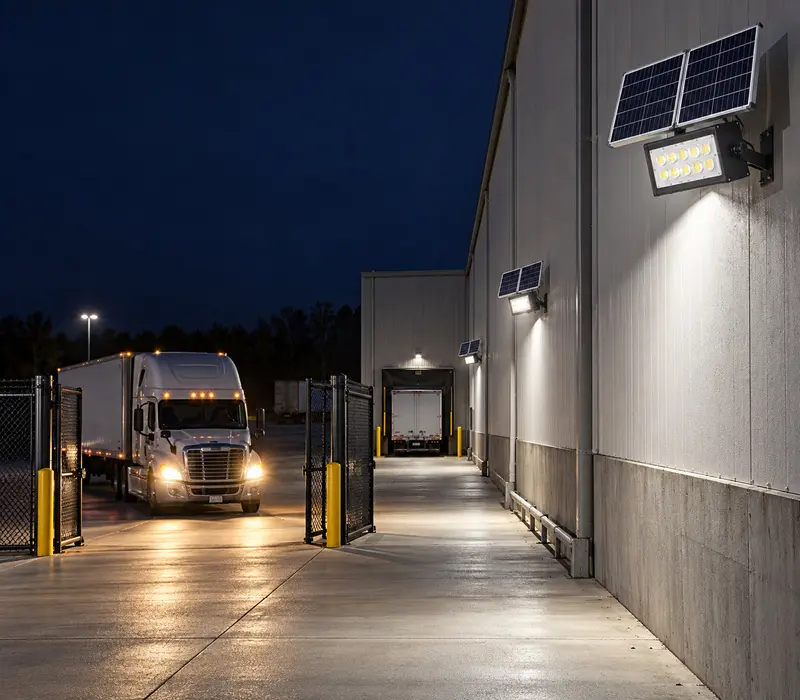
A little after two in the morning, headlights swing across the empty wall of a warehouse. A truck is easing through the gate, hours after the day shift left. The gate light wakes up first. Two units beside the loading lane follow. By 2:22, the driver is at the bay and the yard has gone back to its dim overnight level. That is a motion sensor solar flood light doing its job: light only where and when it is needed. Nothing dramatic happened, just the right lamps coming on when a driver needed them. This is the everyday work of the sensor. The difficult bit isn’t buying the sensor. It is agreeing on what should happen at 2:10 a.m., and who is responsible for keeping that agreement current. That agreement is a set of decisions: how the lights brighten, for how long, how they dim, and when they go back to rest. In this guide, we explain how a Tuya solar flood light system uses motion sensors, dimming and schedules to save energy from a practical angle. It covers what triggers a change in output, how the light behaves during a visit, and how schedules, modes and local control fit together. It also describes the recurring failure points, where savings are most likely to be lost, and the paperwork needed to keep them there. That means the idea of overnight readouts and schedules can be used for energy management. The goal is not to switch off a large amount of light immediately. A small fraction of output kept during quiet hours can combine with a schedule and save energy. That is the whole value of a light with a motion sensor. How Motion Sensor Solar Flood Lights Work Brochures tend to place sensing, scheduling, and dimming shoulder to shoulder. On the job, they happen in sequence. First, something should provide a reason to change the output. In practice, that reason is one of three things: a recorded activity, a schedule, a condition that the app has been told about, or a remote command. Think of the schedule as the boundary around the rule; it might apply only after the last shift has ended. A schedule asks whether today is the same day as yesterday, or whether a delivery arrived at an unusual hour. Figure out what triggers the change before deciding how much light to provide. When we review a project, the rule is written as if we were explaining it to the night guard. From experience, the words “Standard sensors” are never enough. Instead, we agree on named events, such as “At 2:10 a.m., the first delivery of the night triggers the gate light.” That test question is equally useful when a client asks why the neighbours’ units also wake up. Planning the Motion-Detection Area The smooth fan shape on a sensor diagram never shows the messy bits of a real yard. It misses the trees, the passing traffic, the reflective fence, and the corner of the building that blocks half the lane. The diagram can claim a coverage pattern, but the live test decides the working area. That is why the planning needs to happen on the ground, rather than in the catalogue. A sample installation settles many of these questions. With the lane chalked out, someone should walk the delivery route at the right hour, then note which units wake and which stay dark. The walk should also check the approach from the gate, the yard edge and the spaces behind the stored pallets. We prefer at least one check after dark. After dark, the crew finally sees the beam in context. They can see where the light lands, how long it lingers, and what it hides. When the crew agrees, the plan gains a usable boundary, and the bright areas stop drifting during installation. The test sheet doesn’t need polish. We use a few practical columns for the model and sensor, where the trigger happened and what was observed. The sheet should also record the date and time, and whether the unit was checked in its normal operating state. A simple record like that has more value later than a memory that starts, “We think the sensor was fine.” How Dimming Rules Affect Energy Use Every solar fixture begins the evening with a limited store of energy. The busy question is how long the light should stay bright after an event. Brightness that serves no one should fade, not stay bright all night. Imagine identical units at two gates. The storage gate opens twice overnight. The residential gate sees occasional late traffic. With schedules and dimming, each unit’s light level can adapt. That is why a dimming rule matters as much as any battery figure. Sizing therefore starts with an estimated night profile. The useful inputs are local night length, how many visitors arrive, how long each stay is in the plan, and what fraction of full output makes sense after the last visit. Those are the assumptions that matter most. When combined with the profile, runtime, charging, and brightness can be checked together. If traffic is still a guess, we start cautiously and read the pilot unit’s record later. That keeps the design honest and the trial can be extended. A pilot light can be watched for a month. The following season can then use the same input information in the plan. App Accounts and Connectivity Requirements The named HC-WT3-A100W is a Tuya-controlled solar flood light. It can provide Tuya control from a phone or computer, with app-based scheduling and remote dimming in daily use. The Tuya connection uses 4G with a built-in chip. That makes the account setup part of the decision, not an afterthought. The account is easy to overlook at purchase time. Later, it can become the awkward part. Who owns it? Who can change the schedule? How does a shift build a new rule? If ownership is unclear, a crew can find itself with a phone that controls a light nobody can touch. Get the answer in writing before the fittings arrive. In the handover file, each app name should sit beside its physical location. We also capture the live state of the fitting. That matters when the new facilities person asks who owns the light at the far end. Then disconnect the network during the acceptance discussion, at least conceptually. Which functions should continue locally if connectivity disappears, and how should the sensor behave if it is powered off? A written answer is worth more than a confident sales statement. If the proposed controller changes behavior without a network, note it. Otherwise, doubt it. What the Status Screen Can Show The customer material for the Tuya unit describes online operating-status checks and automatic fault alerts, with remote power pricing on the group level. That means the status view is useful as a first check, not a full diagnosis. A reading of the panel tells the operator where to look first. The physical check still settles the question. The exact screen content should be confirmed for the quoted controller. It may include device state, fault alerts, online status, and remote dimming controls. That information is worth listing for the buyer. A stated function that no one can find on the screen is not really a feature. Commissioning can be simple. Open the correct group, locate the fixture by its site name, and send a command. At that point, check that the intended light responds and that unrelated groups stay dark. If the right light doesn’t answer, the assignment needs to be corrected before the crew leaves. That is the moment when the map, the app and the yard finally agree. Site Information to Confirm Before Configuration Our first question is usually about the night shift, not the app. Perhaps the manager locks the yard at midnight, or perhaps deliveries arrive all night. It may be that the crew keeps a gate open for a forklift, or that the yard is only used for storage. The mode choice follows these answers. For the quiet warehouse, a sensible first trial could be low light after closing, followed by a temporary lift to full brightness on detection. It is a trial configuration, not a final setting. A month of quiet nights will show whether the trial is worth keeping. Werise lists Tuya-controlled options in its product range, and a category of AI IoT solar flood lights shows the fitting family. A plan and quantity get the inquiry started. The useful detail is what follows sunset: when the doors open, who needs light, how long the delivery takes, and which areas can stay dim. That detail decides how the controls are set, not the shape of the fitting. For the solar side, we need the location and any shade, plus the seasons that cause concern and how the charger fits. Upgrades stay plausible. A written plan for solar, storage, and light keeps everyone on the same page. It also makes the follow-up call easier. The details are standard for a solar flood light enquiry. The proposal can then name every main part instead of leaving the hardware behind generic labels. It should cover the fixture, controller, battery, and sensor. The names matter, because some sites need a replacement part years later. Some sites need more than a single connected fixture. The AI IoT solar lighting range covers wider site-level control where single fixtures are not enough. Send the plan and that night-time story through the Werise contact page. We can then look at the visit, the dimming, and the trial together. The first answer is better when it follows the site story. Related reading: for the platform behind Tuya control, see A Beginner’s Guide to Smart Solar Flood Lights Powered by Tuya Platform; for choosing brightness by task and coverage, see Choosing Solar Flood Light Brightness: Lumens, Coverage and Site Conditions; and for shorter days and cloudy weather, see Solar Flood Lights in Winter: How to Plan for Shorter Days and Cloudy Weather. Motion Sensor FAQs What is the detection range and angle of the sensor? The HC-WT3-A100W product page lists no sensor detection range or angle, so there is no model-specific figure to quote. As a guide, typical PIR flood-light sensors cover roughly 8-12 m in homes (up to 20 m commercial) with a 90-180 degree field of view, and mounting height and aiming change the working area, so plan the area on the ground and walk-test it after dark. Sensor detection range, angle and delay are customizable to project and customer requirements. On site, plan the detection area and walk-test it after dark, as described above. Does the HC-WT3-A100W use a PIR or microwave sensor? The product page does not state the sensor type. Typically, most solar flood lights use a PIR sensor, which detects body heat and movement; microwave sensors, as a guide, detect movement through thin materials and can be more prone to false triggers. Confirm before ordering — the product page does not state the sensor type. Ask for: the sensor type (PIR or microwave), what triggers it, and how it is set for the quoted controller. How long does the light stay on after motion is detected? The product page lists no delay or hold time, but the Tuya app timer/schedule control for the HC-WT3-A100W lets you set when the light is on. Typically, as a guide, the on-time after motion is adjustable from about 10 seconds to 5-30 minutes, and the light can then dim rather than switch off. Sensor detection range, angle and delay are customizable to project and customer requirements. Write the rule as if explaining it to the night guard, as described above, and get it in writing. How do I stop my motion sensor flood light from false triggering? Plan the detection area on the ground, not from the catalogue diagram: the diagram’s smooth fan shape misses trees, passing traffic, reflective fences and building corners that block the lane. Walk the route with the lane chalked out, check after dark, and record the model, sensor, trigger point and observation on the test sheet. For sensitivity and aiming options on the quoted controller, confirm before ordering. Also mount 8-12 ft high at a 25-30 degree downward angle, as typical industry ranges, not WT3-A100W specifications, start at medium sensitivity and walk-test the zone. Angle the sensor slightly down to focus on human-height movement, and keep it away from heat sources, reflective surfaces, moving cars and strong electromagnetic interference; do not aim it at the sun. Confirm the exact detection range and delay for your model before ordering – these vary by model. Why did my solar flood light stop working after a few days of use? Before first use, place the solar light in a sunny area for 2–3 days — a typical industry range, not a WT3-A100W specification — to charge, and make sure the solar panel faces the sun. New units ship with a partially charged battery; using them immediately drains it before the panel can refill it. Why is my solar flood light dim or flickering? Dim usually means the battery is not fully charged — a dirty, shaded or wrongly angled panel, or an ageing battery (a healthy LiFePO4 cell reads about 3.2–3.3V (a typical industry range, not a WT3-A100W specification)) — or the light is in a dim/energy-saving mode. Flickering usually means low battery power or a loose wiring connection: charge fully in direct sun first, check the wiring, and if the battery is old, replace it. Quick test: cover the panel with a towel to simulate night — if the light comes on, the sensor works and the problem is charging, not the LED. Can solar flood lights stay on all night automatically (dusk to dawn)? They turn on automatically at dusk and off at dawn, but “all night at full brightness” depends on the battery: lights often die after a few hours on dusk-to-dawn mode. Practical advice: set the light to stay on about 3 hours per night (a typical industry range, not a WT3-A100W specification), or use motion or timer modes. Some models claim 12–14 hours per charge (a typical industry range for some models, not a WT3-A100W specification) with LiFePO4 batteries and remote brightness/timer control — check the battery capacity and the dimming profile behind the claim before relying on it. Why does my solar light only work when the panel is faced down on something? The light is exposed to light from another source, such as a street light. While the solar cell is actively generating electricity, the light stays dark — the dusk sensor thinks it is daytime. Fix: aim or shade the light so no other light shines on the solar cell or panel.
