Solar Street Light Price: What Decides the Cost of an AI IoT System
noviembre 19, 2026
 Werise Engineering Team
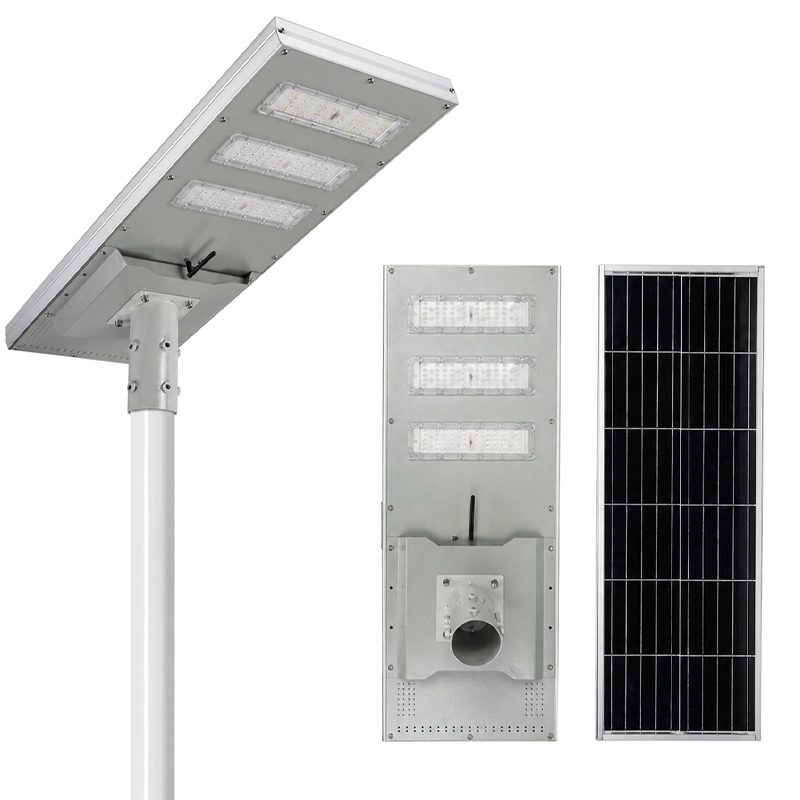
An all-in-one solar street light puts the panel, battery, LED and controller in a single housing. One unit goes up the pole, and the configuration is fixed — what you order is what you get.
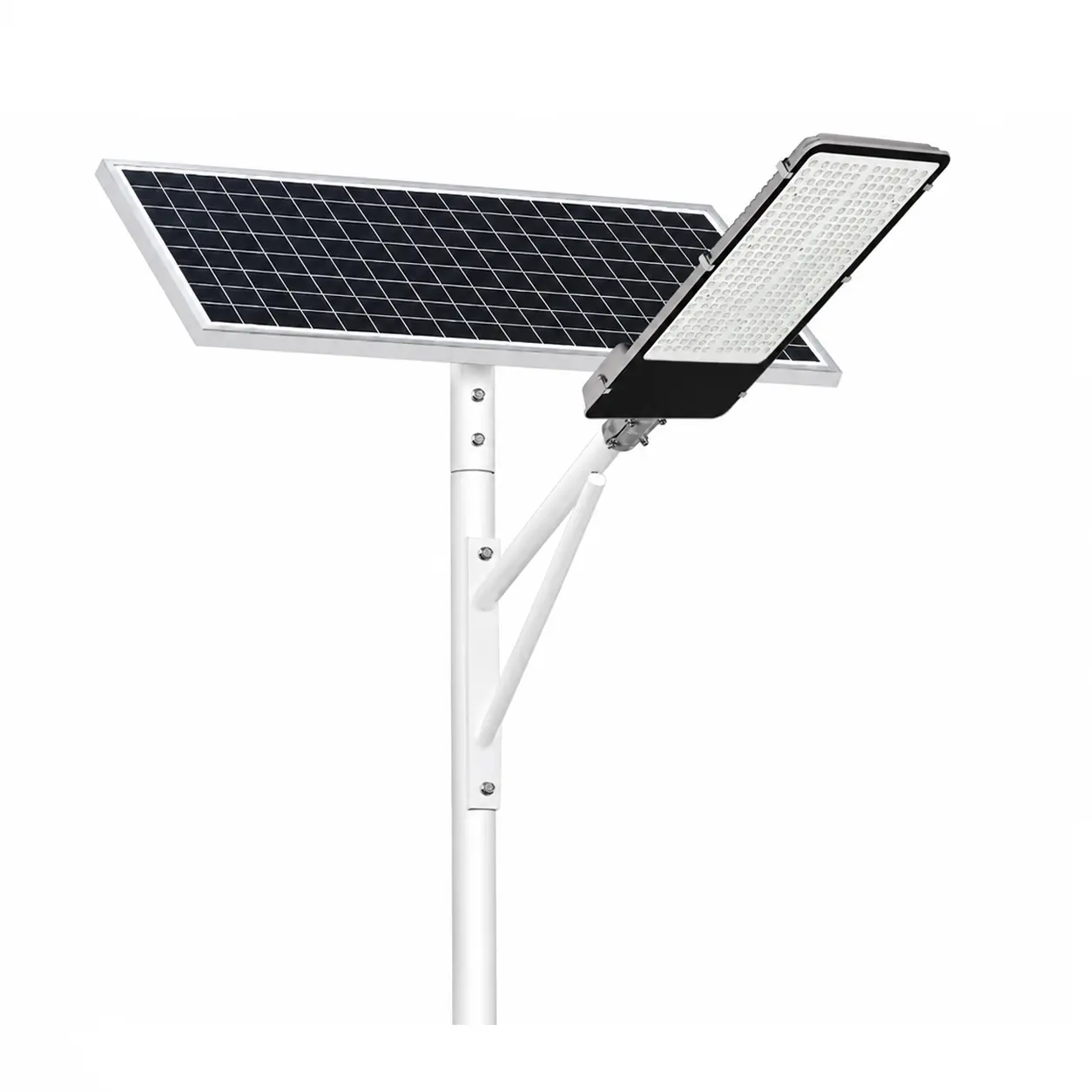
A split solar street light keeps the parts separate: the light head, the solar panel and the battery box are individual components, each sized for the project. Werise’s street lights use separate components. HC-JDSL-02 is named a split system on its own product page. HC-CZSL-39 keeps its battery in a separate external battery box, plug-connected to the lamp body. HC-ZY-01 lists its panel and battery as separate components sized per model.
So the choice is not about which form is “better” in general. It is about how much the project needs to configure — power, panel, battery and pole height — and how the parts are put together on site. This guide compares both forms, then uses Werise’s split systems as the worked examples.
HC-JDSL-02 is Werise’s split solar street light, and its product page lists every part as a separate, configurable item:
The product page states the reason for the separate battery box directly: the external battery design makes inspection, maintenance and replacement more convenient. The panel, battery and LED power can each be configured to suit municipal roads, industrial parks and other outdoor applications.
An all-in-one puts the panel, battery, LED and controller in one housing. There is one unit to mount and no wiring between components. The configuration is fixed at the factory: the panel size, battery capacity and LED power are set for that model, and the panel angle is fixed by the housing — so the bracket or arm direction sets the panel orientation, not a separate panel mount.
That form suits projects where the required power is modest and the configuration is standard: one unit, one mounting step, a clean look. Its limit is configurability. A bigger battery or a differently aimed panel means a different model, not a different configuration of the same model.
No Werise street-light model in this guide is presented as an all-in-one. Werise’s CZSL-39 and ZY-01 lines keep the battery as a separate component — CZSL-39’s battery is an external battery box — so a buyer comparing a true one-housing all-in-one against a Werise model should compare the battery arrangement, not just the wattage label.
| All-in-one | Split (Werise HC-JDSL-02) | |
|---|---|---|
| What it is | Panel + battery + LED + controller in one housing | Head, panel and battery box as separate components |
| Panel | Fixed to the housing; angle set by the bracket/arm | Separate; 100–200W 18V, sized per project |
| Batería | Inside the housing, fixed capacity | External battery box; 3.2V / 6.4V / 12.8V / 25.6V LiFePO4, capacity matched to the project |
| Power range | Fixed per model | 400–800W configurable (JDSL-02) |
| Controlador | Varies by model | AI IoT MPPT (PC & App, light & remote control) on JDSL-02, CZSL-39 and ZY-01 — the controller is not the differentiator |
| Instalación | One unit to mount | Three components to mount (head, panel, battery box) |
| Mantenimiento | Whole unit comes down for service | External battery box: inspection, maintenance and replacement more convenient (JDSL-02 product page); CZSL-39 battery box is plug-connected for easy maintenance and replacement |
| Rainy-day backup | Fixed by the model’s battery | Sized per project; CZSL-39 states up to 3 rainy days in dimmed mode — for JDSL-02 confirm before ordering |
Werise’s fixed-pair models sit between the two forms in practice: HC-CZSL-39-150W pairs a 70W 18V panel with a 75Ah 3.2V LiFePO4 external battery box (150W, 27,000–30,000 lm, 6–8 m mounting, lighting area 30–50 m²); HC-CZSL-39-100W pairs a 60W 18V panel with a 60Ah 3.2V LiFePO4 external battery box (100W, 18,000–21,000 lm, 4–6 m mounting, lighting area 20–30 m²); HC-ZY-01 pairs panel and battery per power model from 25W to 80W (panel 18V 25–80W; battery 3.2V 20–80Ah; mounting 3–8 m by model). The panel and battery are matched per model, not configured freely — but the battery is still a separate external box, not sealed inside the housing.
Choose a split system (HC-JDSL-02) when the project needs the parts sized individually: higher power (400–800W), a larger battery, a panel aimed independently of the head, or taller poles. The Guangxi project in section 6 is that case — 12 m poles with two heads, two panels and two batteries per pole, a configuration no fixed unit carries.
Choose a fixed-pair model (HC-CZSL-39 or HC-ZY-01) when the project’s needs match a standard configuration: 100W or 150W with a matched panel and battery, 4–8 m mounting, and the external battery box arrangement. The panel and battery are already matched for the model, so the decision is which model, not which parts.
Choose a true all-in-one (market form) when the project wants the simplest install and the fixed configuration fits the road — and check two things before ordering: how the battery is accessed for service, and whether the fixed panel angle suits the site’s sun exposure. A panel facing the wrong way can lose a large part of its charge, and on an all-in-one the bracket or arm direction is what sets it.
Do not choose on wattage alone. Two “150W” lights can be an all-in-one with a fixed battery and a split system with a configured battery — different systems under the same label.
El Guangxi industrial access-road project used HC-JDSL-02 Custom AI IoT Split. The case page records: 12 m poles; two 200W LED heads per pole; two 160W monocrystalline panels and two 6.4V 100Ah batteries per pole; AI IoT MPPT controller. Actual operating power is 60W per head against the 200W rating, at 198 lm/W.
That is the split argument in one project: the heads, panels and batteries were each sized for 12 m poles on an industrial access road, and the battery bank per pole (two 6.4V 100Ah packs) is far larger than any single housing could carry. A fixed all-in-one could not be configured this way — the project would have needed a different model, not a different configuration.
El HC-CZSL-39-150W product-page FAQ states what Werise asks for: the project country/city, road or site dimensions, pole height and spacing, required operating hours, quantity and any special requirements. Add one line for this decision: whether the project needs a split system with configured parts, a fixed-pair model, or — if the site suits it — a true all-in-one form. If the inputs are not settled, Werise recommends from them; do not order on wattage alone.
Two commercial facts that affect planning: there is no MOQ — even a single unit can be customized — and lead time is 10–30 days (factory-confirmed 2026-11-14). Confirm the lead time for the exact configuration before ordering, because a custom battery or panel configuration is not a stock item.
Q: Is Werise’s HC-CZSL-39 an all-in-one solar street light?
A: No. Its battery is a separate external battery box, plug-connected to the lamp body — the product page states this directly. The panel is sized per model (60W 18V for the 100W model, 70W 18V for the 150W model). It is a separate-component design, not a single sealed housing.
Q: Can a split system use a bigger battery than an all-in-one?
A: Yes. On HC-JDSL-02 the battery is configurable — 3.2V, 6.4V, 12.8V or 25.6V LiFePO4, capacity matched to lighting power, operating hours and local sunlight. On HC-CZSL-39 the battery is fixed per model (60Ah for 100W, 75Ah for 150W). Battery size is part of the configuration, so compare the battery, not just the wattage label.
Q: Does a split system take longer to install?
A: Structurally, yes — the head, panel and battery box are three components to mount, against one unit for an all-in-one. Confirm the installation schedule per project before ordering; this guide states no minute or hour figure.
Q: Do both types use the same AI IoT controller?
A: On Werise’s models, yes. HC-JDSL-02, HC-CZSL-39 and HC-ZY-01 all list the AI IoT MPPT controller with PC and App control, light and remote control. The controller is not what differs between the forms — the panel, battery and housing arrangement is.
Q: Which one should I choose for my road?
A: It depends on power, battery, pole height and sun exposure, not on the form alone. Send the project country/city, road dimensions, pole height and spacing, required operating hours, quantity and any special requirements, and Werise will recommend the model and configuration. Do not order on wattage alone.
Related reading: What are AI IoT solar street lights?, solar street light wattage guide, solar street light installation guide, solar street light price guide, how to choose solar street lights for municipal and rural roads, HC-JDSL-02, HC-CZSL-39-150W, HC-CZSL-39-100W, HC-ZY-01, Guangxi case and Contáctanos.
Send your road width, pole height and hours per night — we will recommend the model and a lighting layout.