Solar Flood Lights in Winter: How to Plan for Shorter Days and Cloudy Weather
-
 Werise Engineering Team
- Октябрь 29, 2026
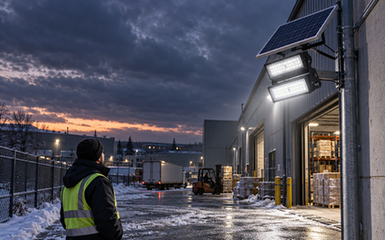
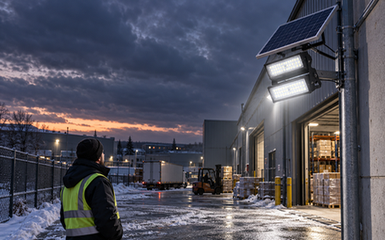
One December afternoon, darkness reaches a warehouse yard before the day shift has gone home. The solar flood light comes on. Near dawn, the supervisor sees that it has not behaved quite as it did in July. That does not prove a fault. July simply supplied a more generous charging day.
That is the awkward truth behind winter sizing. The panel gets a different day while the lamp is asked to cover a different night. Add a low sun, a roof edge, three grey days and perhaps some snow, and the comfortable summer margin disappears. Planning for winter means planning for autonomy across those cloudy days, not for a single clear afternoon.
Winter Sun Hours and Solar Flood Light Charging
On a site visit, I like to stand beside the proposed panel position and look south, east and west before looking at a product sheet. In summer, the sun may clear the workshop roof early. In winter, it can sit behind that same roof well into the morning. A pole, tree or stack of containers that seemed harmless in June can take away a useful part of a December charging window.
The seasonal reason is simple geometry. Across many middle latitudes, a shorter winter day also brings more slanted sunlight. Cloud and other atmospheric conditions further reduce the direct beam. To somebody crossing the yard, the afternoon may look reasonably bright. The panel can tell a different story.
Cold by itself is not the villain. Photovoltaic modules can work efficiently in cold weather. Ice, snow, weak exposure and the long night make the job awkward, with a different mix on every site.
One runtime on a brochure cannot settle winter performance. Before giving an answer, we need the place, panel direction, shadows, lighting schedule, battery condition and the poor-weather sequence being planned for. Runtime comes out of that brief. It cannot travel unchanged from one country to another.
Наш AI IoT solar flood light range brings the panel, LED flood lamp and control system into one project. It still needs somebody to decide which hours matter.
Winter Site Checks Around the Mounting Point
The best time to spot a winter shadow is, unsurprisingly, winter. When that visit cannot happen, take photographs from the proposed panel position through the day. Put nearby roofs, trees and equipment on the drawing, then add direction and tilt.
Access deserves the same attention. Picture the maintenance visit in wet boots. Can the technician see the module and mounting without climbing onto it? Note frozen roof runoff, road dust, falling debris and nearby exhaust. Strong solar exposure is little help if routine inspection becomes unsafe.
Come back after dark and follow the routes people actually use. A loading bay, gate, sign and footpath may share one photograph while doing four separate jobs. The bay could need strong light around two known shifts. The gate may sit quiet for hours before a vehicle appears. Along the footpath, a steady base level might matter more.
Write those jobs on the plan. Do not hide them inside a general note saying outdoor lighting required.
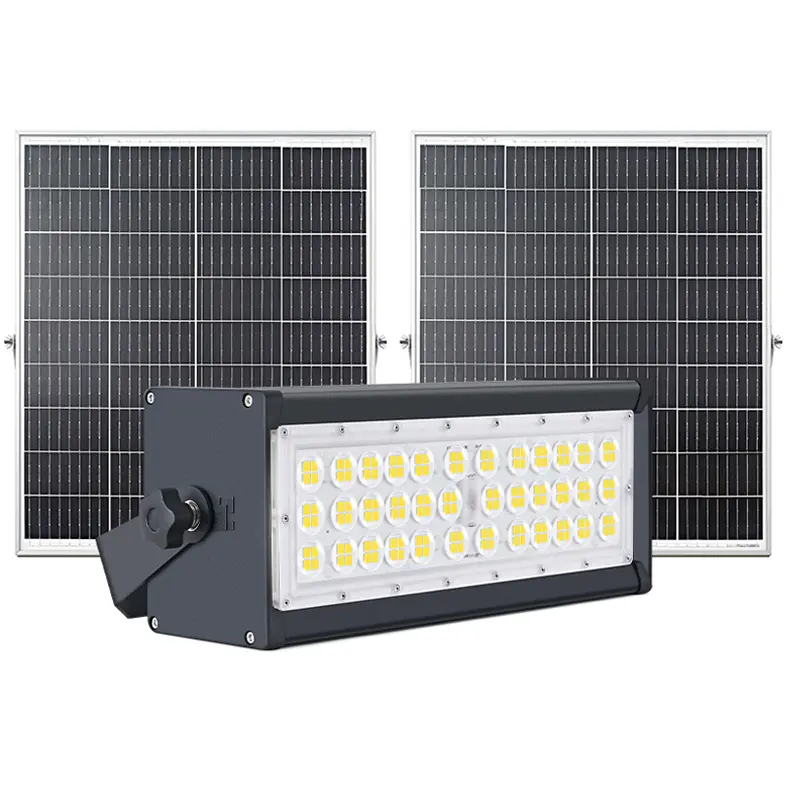
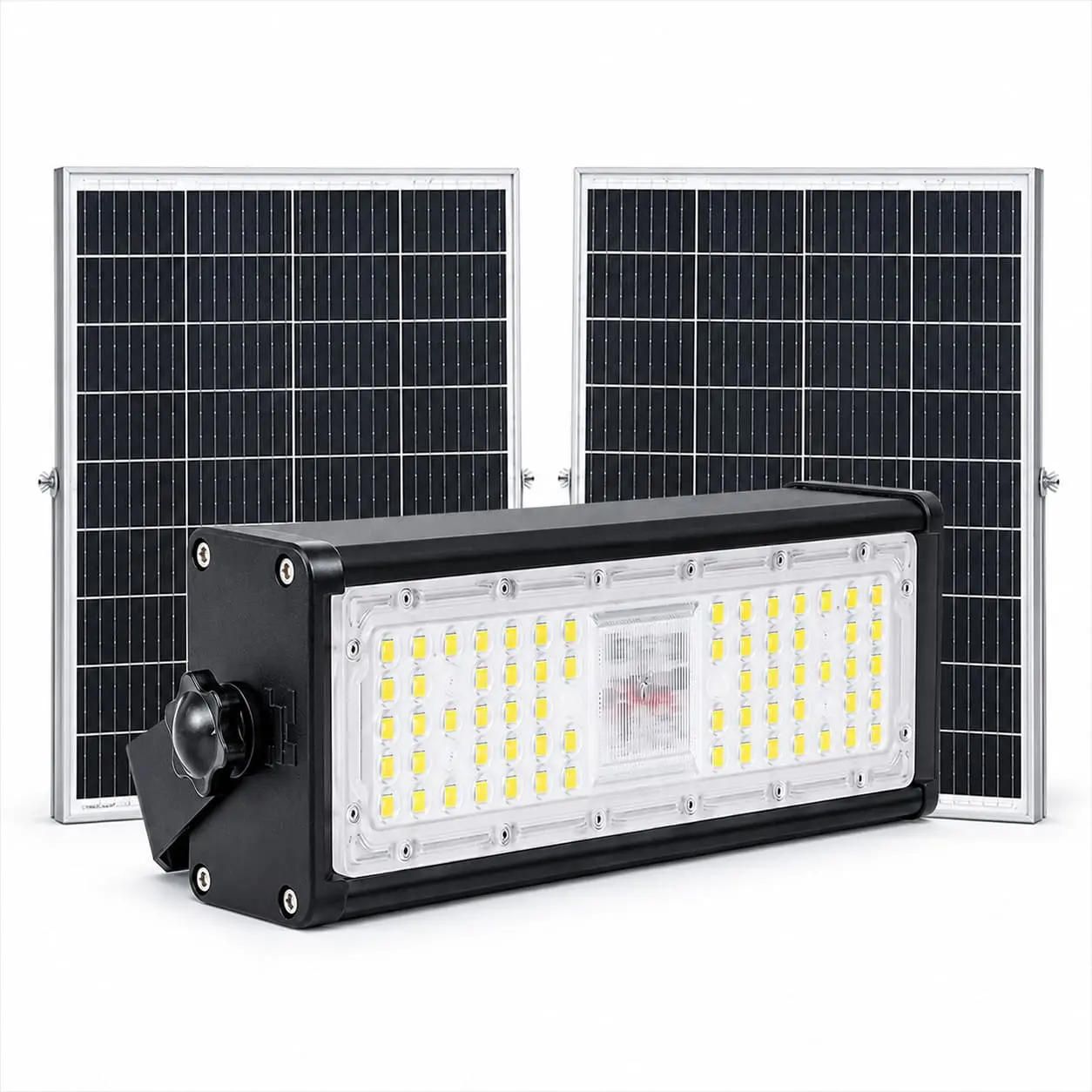
Он HC-WT2-A50W AI IoT solar flood light shows the combined panel, lamp and control arrangement described in our product material. Describe the site and winter duty before choosing the model. A wattage label says nothing about the shadow crossing its panel at ten, or the truck arriving after midnight.
Winter Operating Profiles Between Dusk and Dawn
A useful operating profile looks almost embarrassingly simple. On one horizontal line, mark the busy periods and write the expected light level or behaviour beside each one.
For a warehouse, the first block might cover evening loading. A quieter setting could follow after the gate closes, with a sensor-led lift where the ordered configuration supports it. The working level returns for the early shift. Try that line at a hotel entrance and it quickly falls apart. Similar-looking fixtures do not create similar nights.
Five notes make that profile usable. We need the location and worst season, the panel direction and winter shade, the hours and output expected in each period, likely activity during quiet hours, and the poor-weather reserve the buyer wants considered.
That last note often arrives as maximum backup. It is kinder to the engineer to say what the site should do when energy is tight. Must every zone keep its normal schedule? Can decorative or noncritical lighting finish earlier? Is one access route protected before the rest of the yard? Those are real operating choices. Maximum backup is not one.
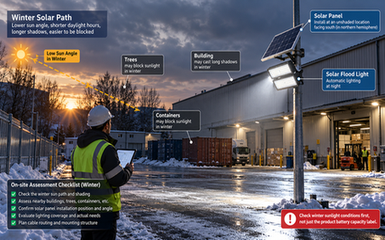
Winter Cloudy Days: Why Three Grey Days Are Different From One
One cloudy afternoon is easy to talk about. A string of weak charging days is where a winter plan earns its keep. Each evening begins before the battery has fully recovered from the night before. Meanwhile, the dark period is still long.
Here the panel, battery, controller and LED load need one review. A thin margin leaves several honest choices. Improve panel exposure where possible, change the night profile, review component sizing, and decide which zones get priority in poor weather.
Guesswork gets expensive. Extra hardware will not remove the shadow from a newly placed container, nor will it correct an overnight setting somebody changed. On an installed system, recorded status or energy information helps narrow the search. Monitoring cannot fill the battery, of course. It can point maintenance to the right end of the system.
Наш Malaysia industrial-zone case shows the same flood lights working through long cloudy and rainy spells — useful for the cloudy-day part of a winter plan, not for cold-climate sizing. The site inputs still rule.
Winter problems: symptom, likely cause, first check
| Symptom | Likely cause | First check |
| Light goes out early in the night | Battery not fully recharged during a short grey day | Check panel shading and the night operating profile |
| Light dimmer than in summer | Shorter charging day and low sun angle | Check panel direction and tilt |
| Light does not come on | Sensor or controller issue, or a snow-covered panel | Cover the sensor briefly to test it; clear snow only as the equipment instructions and site safety method allow |
| Uneven light across zones | Operating profile or settings changed after commissioning | Compare the live schedule with the commissioning record |
Winter Snow: Clearing Panels and Inspecting After the Weather Clears
The tempting response to a snow-covered panel is to get it clean quickly. Quick can be costly. The Department of Energy warns that shovels, standing on modules and putting weight on them may damage the equipment. It also says snow and ice removal, if attempted, needs great care. Where excessive accumulation is removed, the work should follow the equipment instructions and site safety method, using suitable soft tools without loading the module.
This is no job for an improvised ladder visit in a storm.
After the weather clears, look from a safe position first. Broken glass, a frame pulling away, a warped module, shifted hardware or a loose cable all deserve attention. Where access is safe, verify the module fixing. Compare the next production reading with the expected pattern too; one lamp switching on does not prove the whole system is healthy.
Damage or abnormal operation belongs with a qualified person. The applicable isolation and repair procedure should control the work.
The ordinary inspection is quieter. Use the approved method for dirt and debris, then look for fresh shade from vegetation, construction or stored goods. Follow the cable route, inspect the mounting and compare the live schedule with the commissioning record. Quite a few winter problems begin with a changed site, not a changed climate.

Which Werise flood lights suit winter sites?
HC-WT2-A50W — 50W AI IoT solar flood light: 9,000–10,500 lm, AI IoT remote control and dimming.
HC-WT3-A100W — 100W Tuya smart solar flood light: 21,000 lm, Tuya app remote on/off, brightness, 3000K–6000K colour temperature and timer control.
Confirm the rated autonomy for your model and site before ordering.
Winter Project Briefs: Tell Us the Night the Light Must Survive
A quantity and wattage get an inquiry started, but they do not describe winter. Send the site location, a plan or marked photograph, likely mounting points and the direction the panel can face. Show known shade and mention snow, ice, wind or difficult access. If local winter solar data is available, include its source.
Tell us the after-sunset story for every zone. When is it busy? When is it quiet? At what moment would weak light create a real problem? During several poor days, say what the team may reduce and what it must protect. The gate, sign and perimeter need not share an answer.
We also need the target market, requested control functions, available communications, maintenance access and order requirements. If remote operation matters, list the status fields and actions the team expects to test at handover. That prevents smart control from becoming a vague phrase nobody can commission.
Send the brief through the Восстань Contact Page. We will put the solar assumptions beside the panel and battery arrangement, controller behaviour, night timetable and inspection needs. What comes back should be usable by three people: the buyer approving it, the installer setting it up, and the maintenance technician facing that first grey week.
Related reading: for choosing brightness by task, lumens and coverage, see Choosing Solar Flood Light Brightness: Lumens, Coverage and Site Conditions; and for motion sensing, dimming and energy saving, see Датчики движения, регулировка яркости и энергосбережение: интеллектуальные функции солнечных прожекторов Tuya..
Winter Planning in Three Steps
- Describe the night the light must survive: the site, the zones, the busy and quiet hours, and the worst run of poor charging days.
- Check the panel and the profile: direction, tilt and shading, the operating profile, and which zones get priority when energy is tight.
- Confirm the plan in writing: the recommended model and panel angle, the cleaning approach for snow, and how performance will be judged after installation.
Winter Solar Flood Light FAQs
How long will a solar flood light run in winter?
It depends on the site and the model. Work through the three steps above — the night the light must survive, the panel and the profile, and the written confirmation — and confirm the runtime for your model before ordering.
Should I clear snow off the solar panel?
Snow and ice removal is not recommended unless it is attempted with great care — the Department of Energy warns that shovels, standing on modules and putting weight on them may damage the equipment. Where excessive accumulation is removed, the work should follow the equipment instructions and site safety method, using suitable soft tools without loading the module. Confirm the cleaning approach with the product team before the winter season begins.
Should I change the panel angle for winter?
Confirm before ordering — the right angle depends on the site, latitude and mounting. Record panel direction and tilt as part of the project brief, check the panel position and shading, and review whether the panel can restore the battery during a shorter grey day. Ask the supplier to confirm the recommended angle for the quoted model and site.
Do solar lights work on cloudy days or in shade?
As a rough guide, typical ranges are: Yes, but much weaker: a cloudy day gives 20–30% of direct-sun intensity, heavy overcast 10–20%, shade under trees 10–25%, deep shade 2–5% (effectively never fully charges). A light that fully charges in 6 hours of direct sun may need 20–30 hours of cloudy-day light. As a minimum, aim for 4–6 hours of direct sun daily (9 AM–3 PM peak); below 3–4 hours of usable daylight, solar underperforms and wired lighting is preferable. Partial shade is the worst middle ground — dappled light under foliage cuts charging by 30–70%. Treat these as planning ranges — the actual figure depends on the panel, the site and the season.