All-in-One vs Split Solar Street Light: Which One Fits Your Project?
Novembro 20, 2026
 Werise Engineering Team
At Werise, our first check is not a lumen ranking. It is the goalkeeper’s view, the camera position, and the route a lift would take to a failed driver.
Those checks change the comparison quickly. A small fixture count can reduce cost while making coverage or aiming harder. A low connected load only helps if the event brief is still met.
Only then do we compare LED stadium lights for this sport, competition level, site, camera use, audience, boundary, and access plan.
Send every bidder the same site plan, event calendar, and performance reference.
Nosso one-stop lighting service covers product selection and customized configurations.
The plan may be a working drawing. Mark the field, run-off areas, poles or roof positions, mounting limits, seating, and scoreboards. Add roads and homes near the boundary. Draw in temporary screens and stages used for major events. Storage for most of the year does not stop them blocking light on an important night.
Use the calendar for sport, competition level, normal hours, camera positions, and recording modes. A practice pitch and a streamed match venue may share dimensions without sharing a lighting brief.
For the performance reference, name the league rule, governing requirement, project standard, or local criterion behind the illuminance and uniformity target. We would put the citation beside the number. Copying a nearby venue is risky when its competition or camera use is different.
A retrofit needs one more page for constraints. Record existing pole limits, foundation questions, cable and board capacity, and the route for access equipment. Which gate is wide enough, and when may a lift cross the surface? Those answers affect the real installation cost.
An average can look healthy while one corner remains weak. We would read it beside the minimum, maximum, and agreed uniformity result. The calculation grid should include the run-off area that matters to play, rather than ending neatly at the painted line.
Before comparing the coloured plots, compare their assumptions. Pole height, aiming, maintenance factor, target plane, and grid spacing all affect the result. Different assumptions mean the bidders are not yet showing the same job.
Match the schedule back to the calculation. Model, optic, output setting, quantity, and aiming coordinates should agree. Mark any grid point below the requirement and have the designer explain that location in plain terms.
Also look beyond the field. Light toward a stand, access road, nearby window, or the sky creates different concerns, even when it comes from the same fixture.
| Class | Average horizontal illuminance (EN 12193) | Uniformity | Pole height |
|---|---|---|---|
| Class III — training / recreational | 75 lux | at least 50% | 12–16 m |
| Class II — club / regional | 200 lux | — | 16–20 m |
| Class I — national / international | 500 lux | at least 70% | 20–30 m |

Televised matches need much more: vertical illuminance toward cameras of 500–1,000+ lux.
Players track a ball above the field; spectators may face the opposite light bank for an entire match. We would not rely on a plan view to represent either experience.
Walk the goals, touchlines, seats, camera points, and any nearby road with the proposed mounting positions in mind. This does not replace the formal glare review. It gives the designer named viewpoints instead of a general request to keep glare low.
Optic, shield, mounting height, tilt, and final aiming all affect glare and spill. Reducing every fixture may help one viewpoint and leave the playing area short of light. Agree the sensitive boundaries before installation, while an aiming coordinate can still be changed in the model.
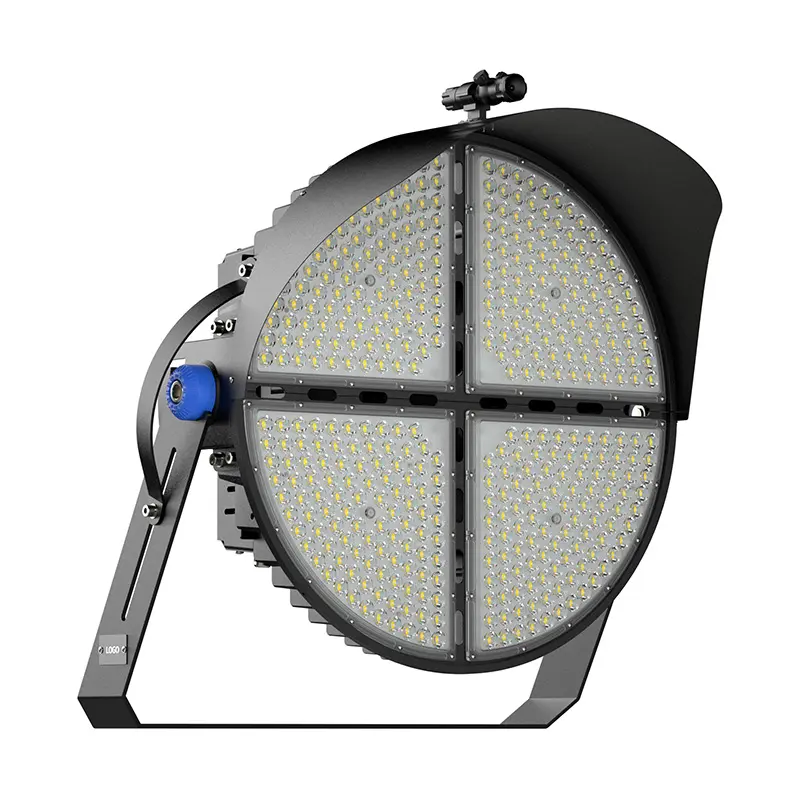
For aiming accuracy, the HC-SD-B has a built-in laser aiming device and a 360° adjustable bracket, with beam angles of 15°/20°/30°/60° — the aiming coordinates agreed in the model are what the crew restores after any driver change.

Camera work has its own brief. Colour rendering and colour temperature matter, along with temporal light modulation. Driver behaviour and the selected dimming scene can affect flicker, so LED package data alone is incomplete.
Send the planned recording modes and frame rates with the enquiry. Ask for a response tied to the quoted luminaire and driver. Where recording matters, put slow-motion footage in acceptance. Do not wait for the first major event to discover bands in the image.
Full competition output is rarely the nightly setting. Training, cleaning, and a security round may each need a different level. Estimate the hours for each scene and the annual energy figure becomes more credible than a simple connected-load calculation. The same discussion clarifies which staff may select a scene.
For a connected product option, review our HC-WT3-C1200W AI IoT stadium light — 1200W, 252,000 lumens, AI IoT remote control and dimming — against the venue’s control brief.
Controls look straightforward in a calm demonstration. Put venue staff at the panel and have them call the approved match scene, then recover it after a power cut or lost control link. A stored scene, local schedule, or manual override can all work; the handover must show which route this installation uses.
A polished dashboard is beside the point when nobody can recover the lights. Failure cases belong in both commissioning and training.
Scene-based hours also expose an energy forecast based on an unrealistically quiet event calendar. The arithmetic and the event assumptions should travel together.
Take one busy week from the venue calendar and assign a scene to each activity. Add the match, training, cleaning, and security hours. Now calculate the operating time for every scene instead of multiplying the maximum connected load by all open hours.
This gives the energy estimate a visible basis and shows whether staff have too many scenes to manage. If the proposed controls cannot reproduce that week simply, revise the scene plan before commissioning. Keep the agreed weekly example with the control schedule for training.
Changing a driver above a stand starts with access and isolation. Price the visit and record how the fitting returns to its original aim. Keep cleaning instructions, protection ratings, and spare parts with that plan.
Nosso HC-SD-B stadium light — 1000W, CREE, 180–210 lm/W, IP66 — uses a separate driver box. Include its proposed location in the access plan.

A similar-looking replacement may use another optic or control interface. Pole labels, aiming photographs, and the as-built schedule tell a later crew what was actually installed.

Turn the warranty into a repair sequence. Name the party handling diagnosis, evidence, access, and labour. A long component term may still leave the venue paying to reach the component.
Set the acceptance method before installation. Agree the measurement grid, instruments, test conditions, and responsible parties. Commissioning should cover every approved scene, basic control recovery, and the required light levels. One centre-field reading cannot confirm the edges or run-off zones.
If testing finds a dark patch, pause before changing several things. Record fixture position, tilt, output setting, and nearby obstructions. The cause could be an aiming error, a wrong optic, a shifted mounting point, or a structure missing from the model. Each one calls for a different fix.
On a retrofit, a representative pilot group can expose access difficulties, control mistakes, glare, and actual installation time. The easiest poles beside the service gate make a convenient trial, but not necessarily an informative one. Include at least some of the awkward positions the full project must handle.
Send the planned recording modes and the aiming coordinates to the operator, and leave a copy in the electrical room.
Select an awkward fitting on the plan. Locate it in the calculation and note its optic, output, and aiming coordinate. Next, trace the access route and the label left for the maintenance crew.
Find that fitting again in the commissioning check and spare-parts information. Which record lets the venue order its driver and restore the aim? Bring scattered answers together in the handover set.
One trace can expose a missing identity, access step, or maintenance reference before the same gap is repeated across the venue.

| Modelo | Poder | Light output | Controlar | Aiming | IP rating |
|---|---|---|---|---|---|
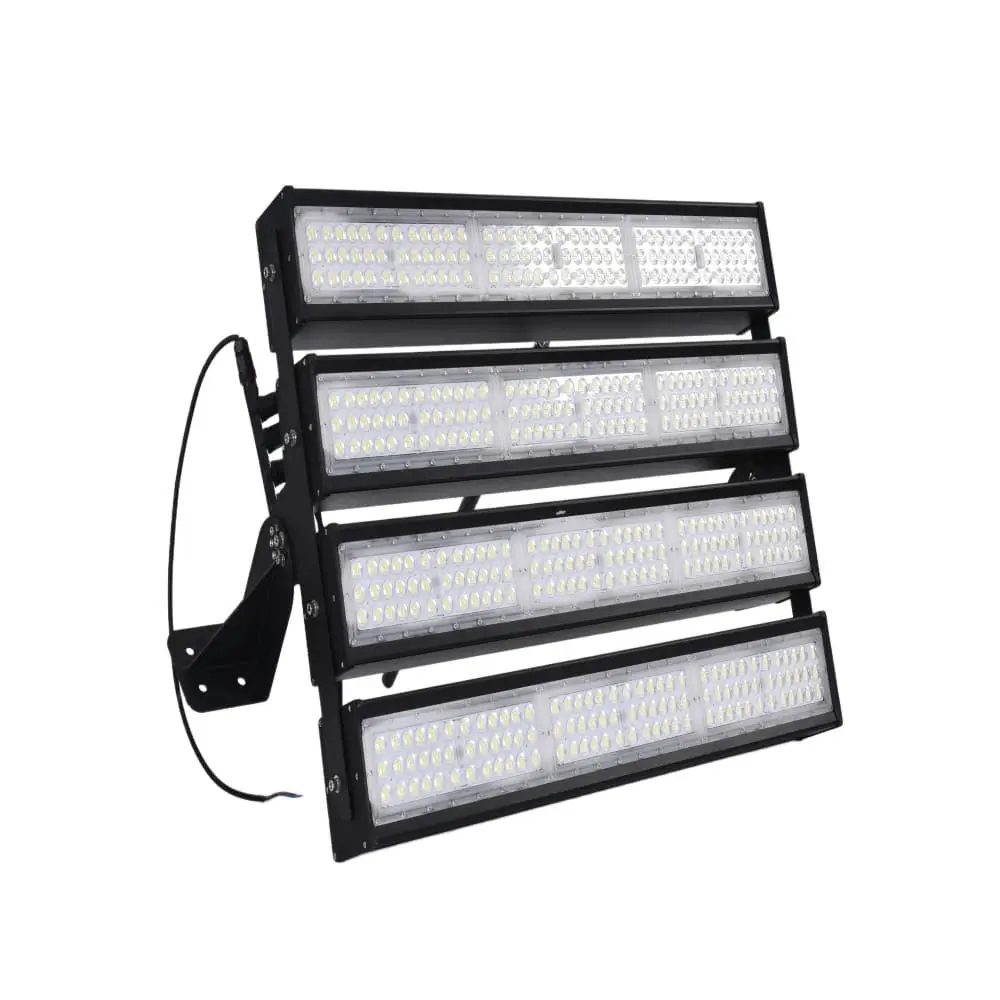
| HC-SD-B | 1000W | 180,000–210,000 lm (180–210 lm/W) | Separate driver box | Laser aiming device, 360° adjustable bracket | IP66 |
| HC-WT3-C1200W | 1200W | 252,000 lm | AI IoT remote control and dimming | — | IP66 |
The HC-SD-B uses a separate driver box — include its proposed location in the access plan.
Werise installed the stadium lighting for the football field at Zhongshan Ninghui School, China: 1500W AI IoT LED sports lighting on 15 m poles, with four primary lighting poles around the field.
The field’s football turf system (AVGDM145-50LS) is certified to the FIFA Quality Programme for Football Turf — FIFA Quality Pro (Field No. 1024720, valid 7 September 2026 to 6 September 2027).

For the final comparison, place the photometric file, calculation, and aiming layout beside the control, glare, commissioning, warranty, and maintenance documents. List exclusions in the same view.
Use the table below — keep performance, cameras, glare, access, energy, and service in separate columns. One combined score can hide the reason for a low price. The saving may be sound, or the offer may simply leave out night testing or control support.
| Proposal A | Proposal B | |
|---|---|---|
| Performance (lux, uniformity, grid) | ||
| Cameras (CRI, CCT, flicker / slow-motion test) | ||
| Glare and spill (named viewpoints) | ||
| Access and maintenance (driver location, lift route, spares) | ||
| Energy (scene hours for a busy week) | ||
| Service (commissioning, warranty as a repair sequence) | ||
| Exclusions |
Choose the proposal the venue can operate and maintain. Keep its approved scenes, aiming details, and calculation in the handover record. If a fitting is later replaced or moved, those records show the operator how to restore the intended result.
Send us your site plan, event calendar, and performance reference to discuss your stadium lighting project.
Why is there no single price for stadium lights?
There is no single price: it depends on fixture count and wattage, pole height and positions, optics, controls, access for installation and maintenance, and the commissioning scope. Send your site plan, event calendar, and performance reference and we will prepare a lighting layout and quotation for your venue.
What wattage do LED stadium lights need?
It depends on the field size, mounting height, competition level, and camera requirements — not on wattage alone. The lighting calculation, uniformity, and glare review decide the fixture count and output. For reference, our HC-SD-B is a 1000W football stadium light and our HC-WT3-C1200W is a 1200W AI IoT stadium light; the right choice follows the venue brief.
Do stadium lights need a separate driver box?
Some do. Our HC-SD-B uses a separate driver box, so its proposed location must be in the access plan — a driver change above a stand starts with access and isolation, and the fitting must return to its original aim.
How many lux do football/soccer fields need?
Under European standard EN 12193 (average horizontal illuminance): Class III training/recreational 75 lux; Class II club/regional 200 lux; Class I national/international 500 lux. Uniformity: the darkest spot should be at least 50% (Class III) to 70% (Class I) of the average. Televised matches need much more: vertical illuminance toward cameras 500–1,000+ lux, professional 800–2,000 lux horizontal, ultra-HD/international 2,500+ lux. CRI 70–80 minimum for competition, 80–90+ for broadcast. Pole heights: 12–16 m recreational, 16–20 m amateur, 18–24 m semi-professional, 20–30 m and above professional. A full-size pitch (105×68 m) at 200 lux needs roughly 3 million lumens installed — for example, about 30 × 1000W fixtures on 4–6 poles, or 12 × 1500W on 6 masts for club level.
What pole height do stadium lights need?
Recreational/training 12–16 m; amateur competition 16–20 m; semi-professional/regional 18–24 m; professional/broadcast 20–30 m and above; ultra-HD international 25–35 m and above. A common design rule: the line from the centre of the pitch to the luminaires should be at least about 25° above horizontal, so players looking up are not blinded. Example layouts: training 8×1000W on 4 masts of 18–20 m; club 12×1500W on 6 masts of 18–20 m; top level 30×1500W on 6–8 masts of 25 m. Note: these are stadium mast heights. The Werise HC-SD-B product page lists a 6–12 m mounting height for the fixture itself (project dependent) — that is the fixture mounting guidance, not the stadium mast height.
How much do stadium lights cost?
Market ranges, not a Werise quote. A single LED stadium fixture costs roughly $250–$1,500 by wattage, beam control and housing. Full installed projects: small community/practice field $20,000–$70,000; high-school football/soccer $100,000–$300,000; college/professional with broadcast $250,000–$1,000,000 and above. Fixtures are usually only 20–35% of the total — poles ($6,000–$15,000 each installed for 60 ft steel), foundations, electrical service upgrades ($20,000–$80,000), crane/bucket-truck time ($150–$400/hour) and engineering make up the rest. LED retrofit of an existing field typically runs $142,460–$343,680 (US 2026 data) and is 30–40% cheaper than a new build because poles and foundations are reused. Send your field size and lighting class for an exact quote.