Municipal and Rural Road Solar Street Lights: How to Choose
-
 Werise Engineering Team
- नवम्बर 13, 2026
Choosing a solar street light starts with the road, not the product. A municipal road and a rural village road need different mounting heights, different coverage, and different maintenance plans — even when the lights look similar. This guide explains how to choose, using Werise’s AI IoT solar street lights as the working example.
Werise is an AI IoT solar street light manufacturer in China, supplying solar street lights, solar flood lights and solar garden lights for commercial, industrial, municipal, residential, rural and community projects in 100+ countries.
1. Start with the road, not the product
Before comparing models, collect these project inputs:
- Road width, traffic type, and whether pedestrians use the road at night
- Pole height and spacing, and the area each light must cover
- Required lit hours per night, and how brightness should change through the night
- Local sun hours, rainfall, and rainy-day risk — this decides battery autonomy
- Access for installation and later maintenance: can a crew reach every pole easily?
Avoid starting with wattage alone. Wattage is only one part of a system that also includes the solar panel, the battery, the controller, and the mounting geometry.
Three mistakes that waste a municipal budget
- Buying on wattage alone. Wattage does not settle illuminance, coverage or rainy-day autonomy — those depend on the panel, battery, controller and light distribution together, so compare the full system for the exact model.
- No rainy-season autonomy plan. Sizing only for clear days leaves the road dark after several grey days, so set the required rainy-day autonomy for the site and confirm it on the datasheet before ordering.
- No maintenance and access plan. If nobody has agreed who reaches each pole, which spares are kept, and what the commissioning record must prove, faults are found late and repairs stall.
2. Municipal roads: coverage, batch control, and evidence
Municipal roads usually need higher mounting, wider coverage, and a way to manage many lights as one portfolio.
What matters most here:
- Remote batch control and fault alerts. When lights are spread across a municipality, operators need to see battery status, power generation, and LED working status without visiting every pole, and to adjust brightness, colour temperature, GPS position, and on/off status remotely.
- A lighting layout, not a single fixture. Ask for an IES/DIALux layout and per-model datasheets. A layout shows whether the chosen pole height and spacing actually cover the road.
- Evidence before a tender. Ask for the exact model, datasheet, test method, warranty, and commissioning record — and which functions will be demonstrated on site.
A worked example at the larger end of the range is the Shenzhen airport parking lot project (October 2026): HC-WT3-A200W flood lights, 200W rated per head with 50W configured operating power, 6 x 100W solar panels and 12 x 6.4V 60Ah battery packs per pole, on 12 m poles. That is a parking-lot / high-mast example, not a rural-road example — it shows how panel, battery, pole height, and remote management are sized together for a large site. Read the full case: Shenzhen Airport Parking Lot — 200W AI IoT Solar Flood Lighting
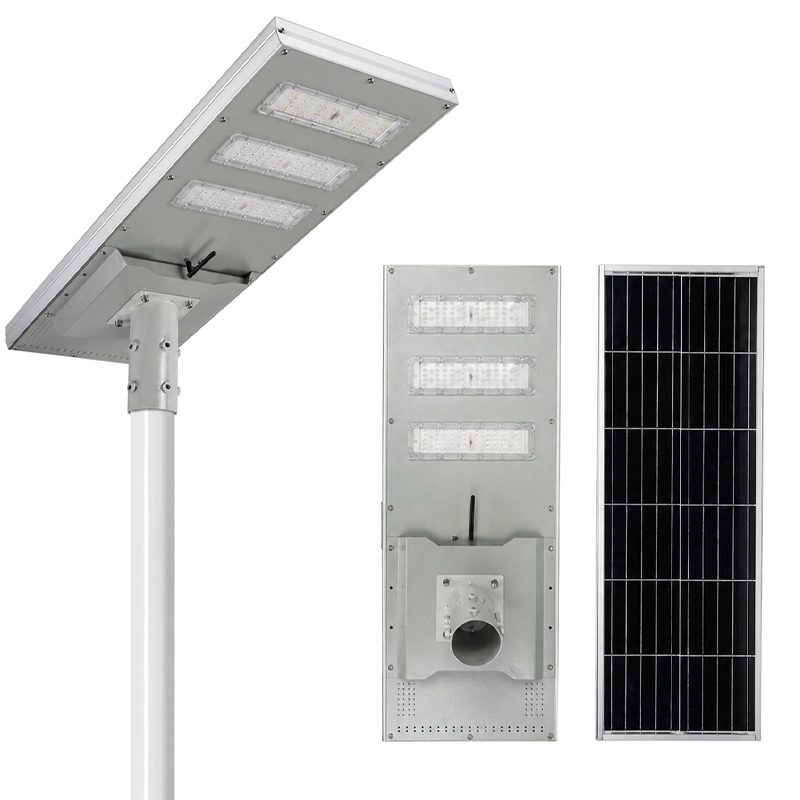
A mid-range road example is the HC-CZSL-39 smart city street light: 150W, 27,000–30,000 lm, CREE 3030 LEDs, IP65, 6–8 m mounting height, 10–12 hours per night in time-segmented dimming mode, with up to 3 rainy days of backup, described on its product page as ideal for roads, parks, rural communities, public areas, and remote projects. Those figures describe that model only. AI IoT Solar Street Light 150W HC-CZSL-39
3. Rural and village roads: prioritise battery, panel, and autonomy
Rural and village roads are often lower-traffic, harder to reach, and more dependent on the light working on its own for days at a time.
What matters most here:
- Battery and panel size over peak efficacy. A LiFePO4 battery and a correctly sized panel matter more than chasing the highest lumen figure.
- Rainy-day autonomy. rated up to 3 rainy days on models such as the HC-CZSL-39. Confirm the autonomy figure for the exact model and location before it goes into a contract — sun hours and rainy days vary by site.
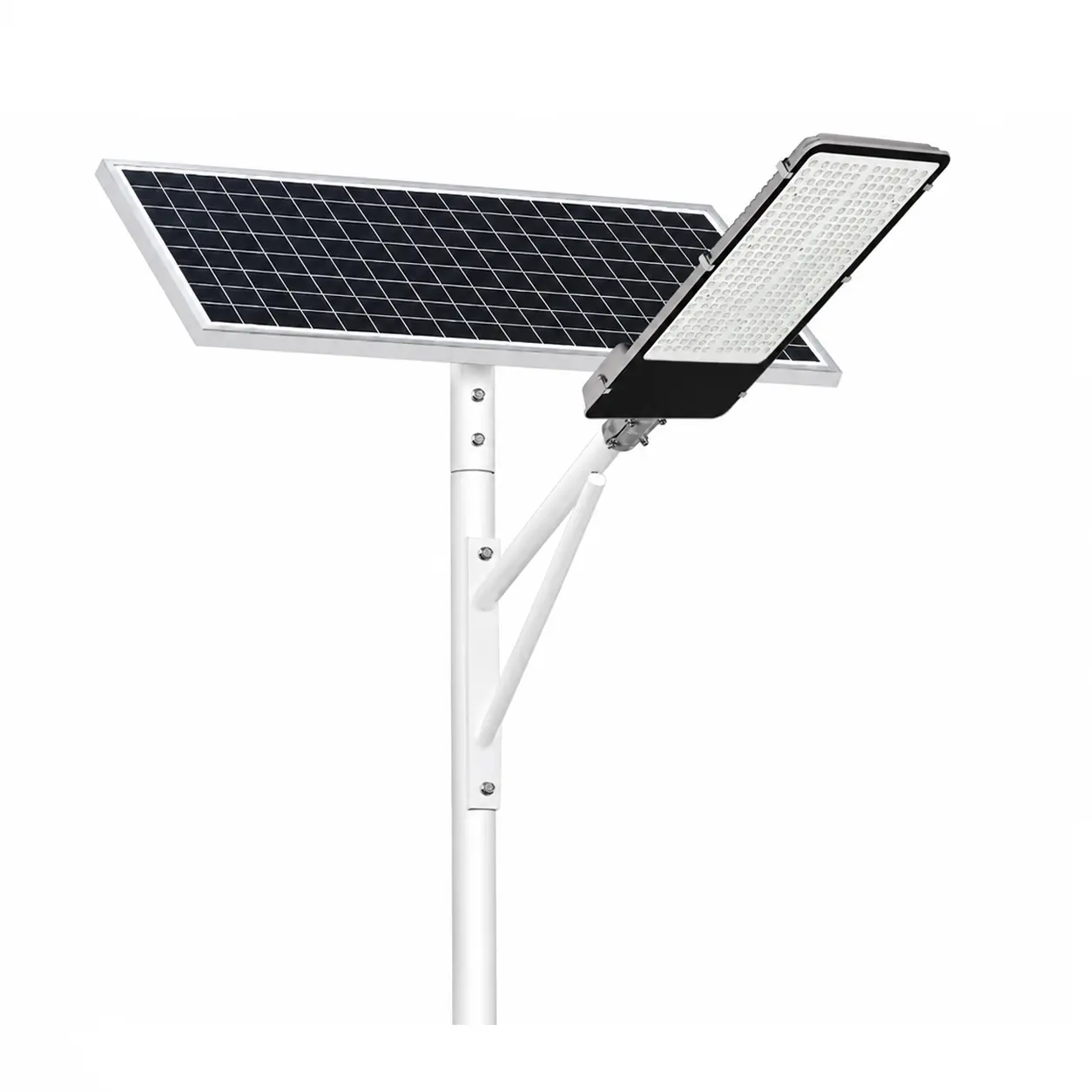
- Mounting that fits the road. As a model-specific example, the HC-JDSL-02 solar street light lists an AI IoT MPPT controller with PC/APP control, 3000K–6000K adjustable colour temperature, a LiFePO4 external battery box, pole or wall mounting, and a 4–6 m mounting height. Those figures describe that model only, not every Werise light.
For a rural road, send the road width, the mounting height you can use, and the required lit hours — those three inputs decide the shortlist faster than a catalogue browse.
4. AI IoT checklist: what to confirm per model
AI IoT adds a management layer around the lighting asset. It should not be reduced to a timer or a remote-control handset. Before buying, confirm for the exact model:
- Remote on/off and dimming, individually and in groups
- Battery and solar monitoring: battery status and power generation data
- Adjustable colour temperature (for example, 3000K–6000K where the model supports it)
- GPS asset tracking and location information
- Fault alerts, and who receives them and how they are closed
- Web and mobile APP management, user roles, and data ownership
Availability varies by model and must be confirmed per datasheet. The existing guide explains the system in more detail: एआई आईओटी सोलर स्ट्रीट लाइट्स क्या हैं? तकनीक, कार्य और लाभों की व्याख्या
5. A practical decision path
| Road | Pole height (guide) | Example Werise model |
|---|---|---|
| Village path | 4–6 m | एचसी-जेडीएसएल-02 — split type, 4–6 m mounting height |
| Residential / community road | 4–5 m | एचसी-जेडवाई-01 — 25–80W all-in-one |
| Municipal road | 6–8 m | HC-CZSL-39 150W — 27,000–30,000 lm, 10–12 hours per night in time-segmented dimming mode, up to 3 rainy days |
| Large site / parking lot | 12 मीटर | एचसी-डब्ल्यूटी3-ए200डब्ल्यू — Shenzhen airport case: 200W rated, 50W configured operating power |
- Decide whether the project is mainly choosing a solar fixture, or managing a distributed lighting asset.
- If the project needs shared status, remote adjustment, early warning, or a structured maintenance plan, weigh AI IoT management alongside the luminaire.
- Ask for an evidence pack tied to the exact model: controller and monitoring functions, installation guidance, and the datasheet figures for your site.
- Separate confirmed product capabilities from functions that need configuration or integration.
6. What to send Werise before a quote
To get a lighting layout and a model recommendation, send:
- Site plan and road width
- Mounting height and pole spacing, if known
- Required lit hours and dimming pattern
- Location, sun hours, and rainy-day expectation
- Whether remote monitoring, GPS, or batch control is required
Contact: send your project requirements via the inquiry form at werisesmartlighting.com/contact-us/.
Frequently asked questions
How many rainy or cloudy days can a solar street light keep working?
Typical industry ranges are: This is called autonomy — the number of nights a light runs from a full battery with little or no sun. As a guide, 2–3 days suits dry climates, 4–5 days is standard for rainy or monsoon regions, and 5–7 days for engineered systems. The datasheet number only means something with the usable battery energy, nightly load and dimming profile stated: usable LiFePO4 energy is about 90% of nameplate, lead-acid only about 50%, and cold cuts usable capacity by about 10% near 0 °C and 25% below freezing. Under heavy overcast a panel still produces 10–25% of clear-day output. For reference, the Werise HC-CZSL-39 is rated for 10–12 hours per night in time-segmented dimming mode, up to 3 rainy days; confirm the autonomy figure for any other model before ordering. Treat these as planning ranges — the datasheet figure for your model is the one that goes into the contract.
What pole height and spacing do solar street lights need?
As a guide: garden paths 3–4 m, residential driveways 4–5 m, small roads 5–6 m, parking lots 6–8 m, urban streets 8–10 m, highways 10–12 m. Spacing is roughly three times the mounting height — for example, a 5 m pole suits 12–15 m spacing, residential roads 25–30 m, parking areas 20–25 m, parks 15–20 m. Pole wall thickness is typically 2.5–4.0 mm by height, in hot-dip galvanised steel. Foundations: 3–6 m poles at least 0.8 m deep; 7–10 m at least 1.2 m; 12 m and above at least 1.5 m, in concrete of grade C25/C30 or better, cured 7–14 days before loading.
Which way should the solar panel face, and at what tilt angle?
Face the equator — south in the northern hemisphere, north in the southern hemisphere. Tilt roughly equal to site latitude for year-round output; steeper by 10–15° if winter output matters most, flatter by 5–10° for summer peak. Even at the equator use at least 10–15° so rain cleans the glass. A panel facing the wrong way can lose about 50% of charge, and mounting flat against a pole can cut charge by about 30%. Check with a compass (correct for magnetic vs true north) and an inclinometer, not by eye. All-in-one lights have a fixed panel angle, so the bracket or arm direction sets orientation — plan arm direction for the sun, not just the road.
Solar street light vs grid-powered LED street light — which is better?
Choose grid LED where mains power exists, illuminance requirements are high, and the road matters — arterials, junctions, tunnel portals. Choose off-grid solar where there is no mains supply, trenching is expensive, or illuminance needs are moderate — rural roads, campus and park paths, new district service roads. Solar costs more per pole upfront, needs no trenching or cabling, and has no electricity bill, but the battery is a consumable and output varies with weather and winter. Grid LED costs less upfront and gives constant dimmable output, but needs trenching and ongoing electricity. Do not compare unit price alone — compare power availability, lighting class and rainy-day autonomy.
All-in-one vs split solar street light — which should I choose?
All-in-one (panel, battery and LED in one housing): 15–30 minute install, no wiring, lower theft risk, cleaner look, 2–5 rainy days of autonomy, practical up to about 120–200W. Split (separate panel and battery): flexible panel orientation, larger battery, 5–10+ days autonomy, higher power (200W and above), easier per-component replacement — but 2–4 hours to install, more wiring, and a ground-level battery box is a theft risk. Rule: below 120W and want speed, choose all-in-one; above 200W, long rainy seasons or harsh winters, choose split. Werise sells both: the HC-JDSL-02 is a split type with an external LiFePO4 battery box, while the HC-ZY-01 and HC-CZSL-39 are all-in-one.